Vehicle theft in the UK has evolved. Keyless relay attacks, signal jamming, and OBD port hacking have made single-layer security systems increasingly easy to defeat. A single device, no matter how advanced, creates one point of failure. When thieves bypass it, there's nothing standing between them and your vehicle.
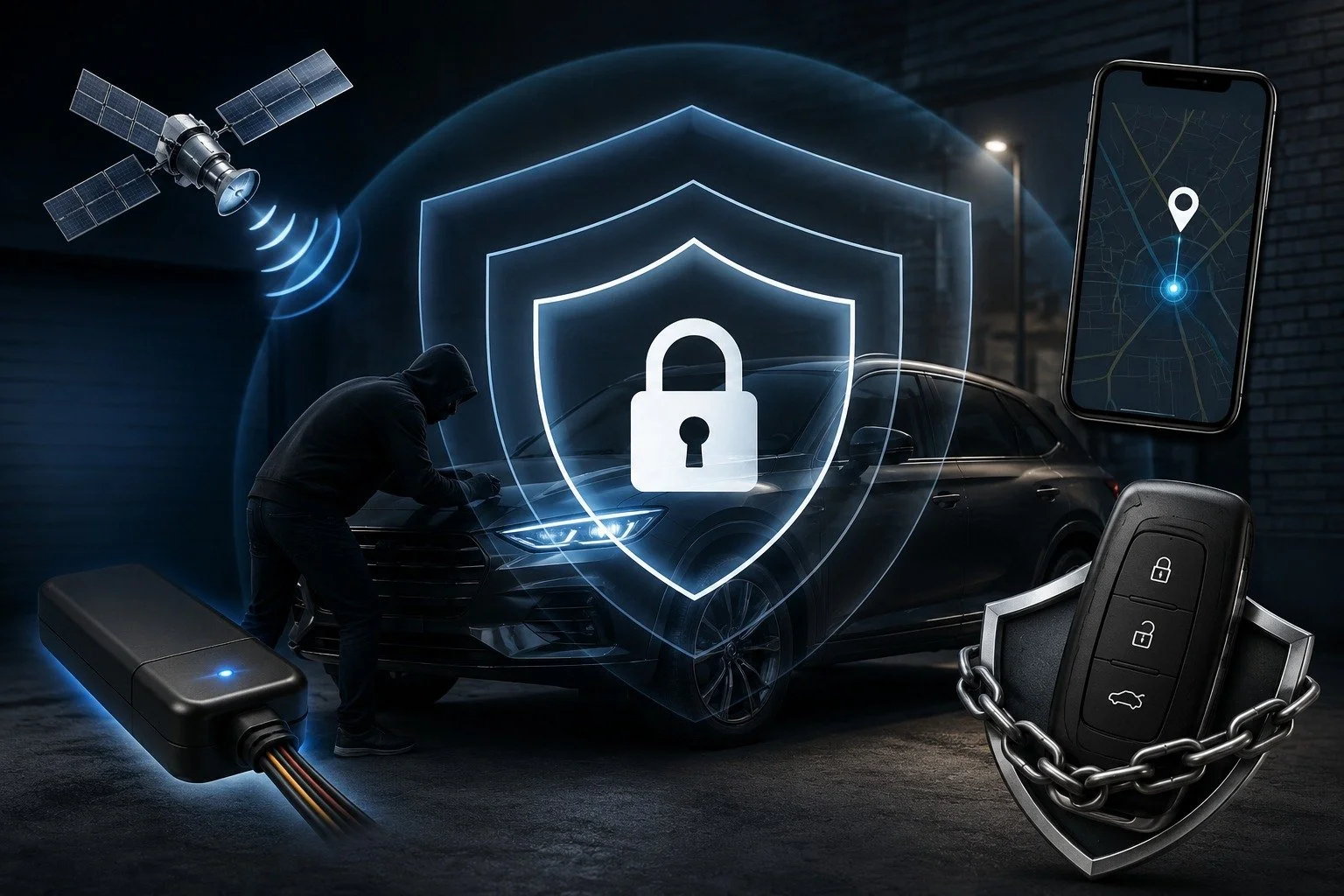
This is where layered security comes in. By combining a tracking system with a mechanical or electronic immobiliser, you create overlapping barriers that address different stages of a theft attempt — from prevention, to disruption, to recovery. At OJB Autocare, this combined approach is the foundation of every security installation we recommend.
How Immobilisers Stop a Theft Before It Starts
An immobiliser's job is prevention. It stops the vehicle from being driven away in the first place by breaking the connection between the ignition and the engine's starting circuit unless a secondary, hidden authentication step is completed.
Electronic vs Mechanical Immobilisers
Electronic immobilisers restrict unauthorised starting. Ghost communicates with the vehicle through its CAN bus and uses a personal disarm sequence entered through existing vehicle controls, subject to compatibility.
Mechanical immobilisers physically lock a critical component, such as the steering wheel, gear lever, or clutch pedal, adding a visible and physical deterrent.
Why Immobilisers Alone Aren't Enough
Immobilisers are highly effective against relay attacks and key cloning, but they don't help once a vehicle is stolen through other means — such as being lifted onto a flatbed truck or towed. This is where the second layer becomes essential.
How Trackers Enable Recovery After Theft
A tracking system provides location information that can support recovery after theft. Capabilities depend on the device, network coverage and active monitoring service. Location reporting does not guarantee that a vehicle will be recovered.
Key Tracker Capabilities
Real-time location monitoring via a smartphone app or monitoring centre
Geofencing alerts that notify the owner if the vehicle moves outside a defined area
Movement and towing alerts that flag suspicious activity, such as movement without ignition
Battery-backup operation, ensuring the tracker keeps transmitting even if the vehicle's main power is cut
Why Trackers Alone Aren't Enough
A tracker can provide location information and alerts, depending on the model. Tracking alone does not provide the separate start authorisation offered by an immobiliser.
The Power of Combining Both Layers
When immobilisers and trackers are installed together, they cover the full lifecycle of a theft attempt:
Prevention — the immobiliser stops unauthorised starting, deterring opportunistic theft and defeating relay attacks
Delay — if a thief attempts to bypass the immobiliser, the extra time required increases the likelihood of detection
Detection — the tracker flags unusual movement or towing activity in real time
Recovery — location data can support recovery efforts, without guaranteeing recovery
This layered structure mirrors how insurers and law enforcement recommend approaching vehicle security: no single device should be relied upon in isolation.
Learn More: Hardwired vs Battery-Powered Vehicle Trackers
Insurance and Thatcham Category Relevance
Insurers increasingly favour vehicles fitted with Thatcham-approved security systems, particularly for high-value or high-theft-risk models.
Thatcham Category S5 covers vehicle tracking systems. It is not the classification for Ghost immobilisers.
Thatcham Category S7 covers asset location systems. Check the exact tracker model, subscription and installation requirements with your insurer.
Autowatch Ghost-II is a TASSA-verified immobiliser, separate from the Thatcham S5 and S7 tracker categories. Combining Ghost with an appropriate tracker can provide immobilisation and recovery support. Your insurer decides whether the equipment meets your policy; premium reductions are not guaranteed.
Which Vehicles Benefit Most From Layered Security
While any vehicle can benefit from combined protection, certain categories face disproportionately higher theft risk:
Keyless entry vehicles vulnerable to relay attacks
High-value SUVs and performance vehicles frequently targeted for export
Vans and commercial vehicles carrying tools or stock
Popular models with known theft patterns and high resale part demand
For these vehicles, layered security isn't a luxury add-on — it's an increasingly necessary standard.
Choosing a Professional Installation
Both immobilisers and trackers need correct installation for the specific vehicle. An unsuitable installation can cause faults or reduce the system's effectiveness. Ask your installer to confirm compatibility, the equipment specification and handover arrangements. Installation should include:
Correct integration with the vehicle's specific electronic architecture
Proper concealment to prevent tampering
Checks against the requirements for the selected tracker and any insurer conditions
Ongoing support and monitoring service activation
Learn More: professional hidden-tracker installation considerations
Conclusion
Immobilisers restrict unauthorised starting, while trackers help locate a vehicle and support recovery. A tracker does not guarantee recovery, and an immobiliser does not prevent every form of theft. Combining the two provides different functions within a wider security plan.
At OJB Autocare, we fit Ghost immobilisers alongside Scorpion trackers. Compare Ghost with Scorpion S5 or S7 tracker packages, check monitoring subscriptions and ask us for a combined fitting quote.
Frequently Asked Questions
1. What's the difference between a tracker and an immobiliser?
An immobiliser prevents a vehicle from starting without authorisation, stopping theft before it happens. A tracker monitors the vehicle's location after it has been stolen, helping with recovery. They serve different purposes and work best when installed together.
2. Do I need both a tracker and an immobiliser, or is one enough?
While either device offers some protection, combining both covers more theft scenarios. An immobiliser alone won't help if a vehicle is towed or lifted, while a tracker alone won't stop a thief from driving away in seconds.
3. What is a Ghost immobiliser and how does it work?
Ghost is an electronic immobiliser that communicates with the vehicle through its CAN bus and requires authorisation before starting. The personal disarm sequence uses existing vehicle controls, subject to compatibility. It adds protection beyond possession of the vehicle key; no device guarantees theft prevention.
4. Will fitting a tracker and immobiliser reduce my insurance premium?
Autowatch Ghost-II is a TASSA-verified immobiliser. Thatcham S5 and S7 are tracking categories, not Ghost immobiliser classifications. Check the exact equipment and installation requirements with your insurer; acceptance and premium savings are not guaranteed.
5. What is Thatcham Category S5 and S7 approval?
Thatcham S5 covers vehicle tracking systems, and S7 covers asset location systems. Ghost-II is a TASSA-verified immobiliser, not an S5 or S7 device. Check your insurer's acceptance of the exact equipment and installation before booking.
6. Can a stolen vehicle still be tracked if the battery is disconnected?
Quality tracking systems include a battery backup that keeps the device transmitting for a period even if the vehicle's main power supply is cut, improving the chances of recovery.
7. Is a mechanical immobiliser as effective as an electronic one?
Mechanical immobilisers offer a visible deterrent and physical barrier, but electronic immobilisers like Ghost systems are generally more effective against modern relay attacks and keyless theft methods, since there's no signal to intercept.
8. How long does it take to install a tracker and immobiliser system?
Installation time varies by vehicle make and model, but most combined tracker and immobiliser fittings can be completed within a few hours at a professional installation centre.
9. Can thieves bypass a Ghost immobiliser?
Because Ghost immobilisers require a unique, owner-set PIN sequence with no transmitted signal, they're significantly harder to bypass than key-based systems, which rely on cloning or intercepting a signal.
10. Which vehicles are most at risk of keyless theft?
Vehicles with keyless entry and push-button start are particularly vulnerable to relay attacks. High-value SUVs, performance vehicles, and popular models with high resale part demand are frequent targets.