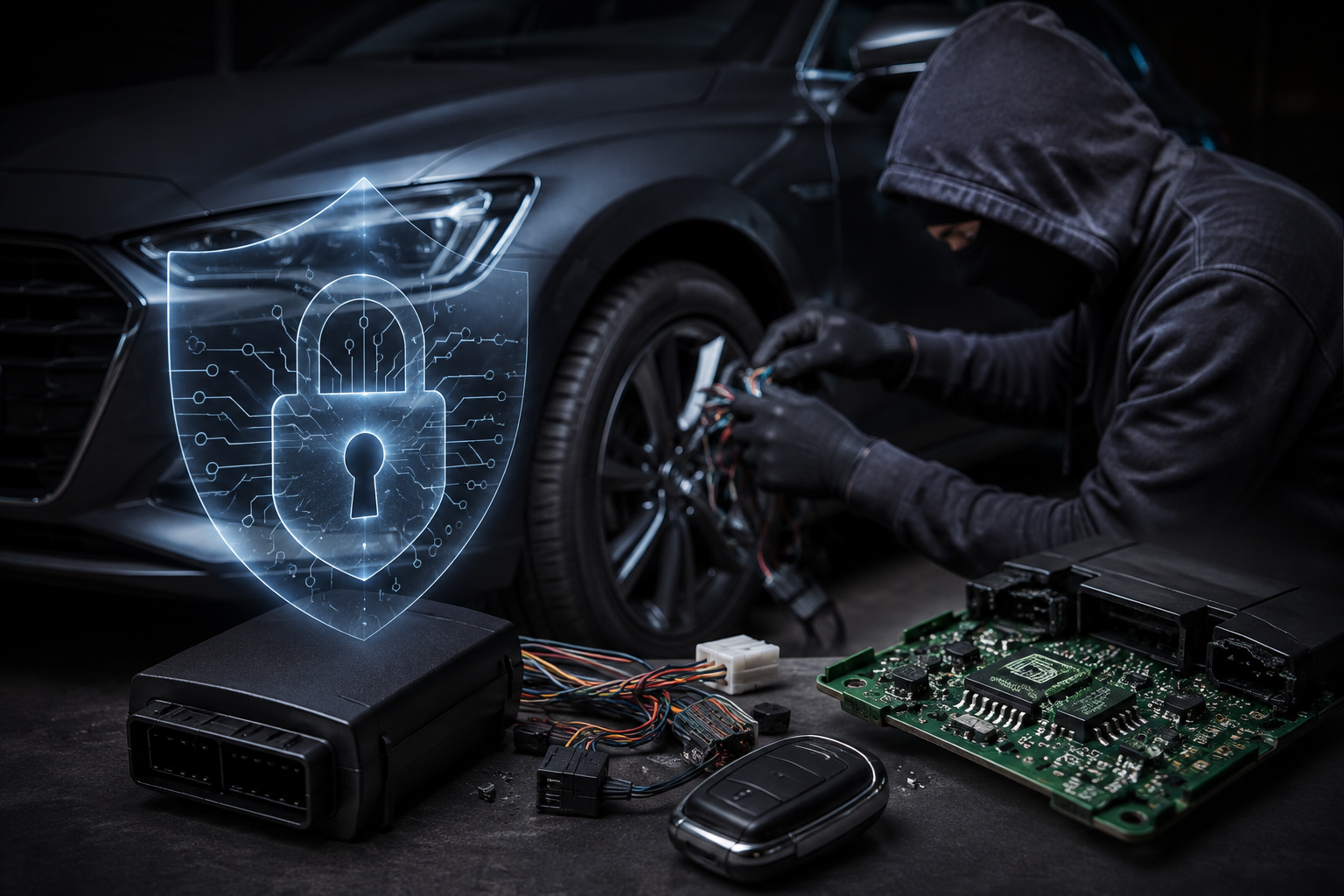
Vehicle theft methods have become much more sophisticated over the past decade. Criminals use relay devices to extend a keyless fob's signal from outside a house, misuse diagnostic-port tools to programme additional keys, and use jammers to stop some remote-locking and alarm signals from reaching the car. Keyless and electronic theft is widely reported because so many vehicles rely on wireless key communication that can be exploited.
Many owners therefore ask whether a Ghost immobiliser can stop a determined thief, or whether it can be bypassed or removed like other security devices. The short answer is that no security device is theft-proof, but a correctly installed Ghost adds an authorisation step that a relayed or cloned key does not provide on its own. This article explains how Ghost resists common theft methods, where its limits are, and how legitimate professional removal differs from tampering.
What Is a Ghost Immobiliser?
A Ghost immobiliser is an Autowatch aftermarket security system that connects to a vehicle's CAN (Controller Area Network) data network and requires an extra authorisation step before the car can be driven. It works alongside the vehicle's own key and factory immobiliser rather than replacing them.
How you authorise depends on the model and how it has been set up. Ghost-II uses a PIN sequence entered on the car's existing controls, such as steering wheel, door panel or centre console buttons, so no extra keypad is fitted. The current Ghost-III can use a PIN, a tag or a smartphone app depending on its configuration, and on applicable vehicles it can support remote engine-running climate features while still preventing the car from being driven.
The CAN network is the internal communication system that allows the car's electronic modules, including the engine control unit, transmission and instrument cluster, to talk to one another. Ghost uses that network to block driving until it has been correctly authorised. Because this step is separate from the factory key system, capturing, relaying or copying the key's signal does not satisfy it on its own.
This is an important distinction. Much of the theft technology developed over the last ten years, from relay boxes to key programmers, targets the factory key. A second, independent authorisation step means that getting past the factory key is no longer enough to drive the car away.
Why Traditional Immobilisers Can Be Bypassed
To understand what Ghost adds, it helps to look at how factory immobilisers and older alarms are commonly defeated. The descriptions below are deliberately general.
Relay attacks exploit keyless entry, which lets the car communicate with the fob when it is nearby. Thieves use relay equipment to extend that communication, sometimes from just outside a front door, so the car behaves as though the key is present. The doors can unlock and the engine can start without the key ever leaving the house.
OBD key programming takes advantage of the diagnostic port fitted to modern vehicles. The port is needed for legitimate servicing, but key-programming equipment can be misused through it to add a new key to the car. Once accepted, that key works like an original.
Signal jamming interferes with the radio signal sent when a driver presses the lock button. If the signal does not reach the car, it may not lock or arm, even though the driver believes it has.
Wiring tampering is a more manual method. Some older aftermarket immobilisers and alarms were wired in predictable ways on familiar models, which made them easier to interfere with.
Ghost immobilisers were designed to address several of these weaknesses, particularly the methods that depend on defeating the factory key. It is worth walking through how.
Can a Ghost Immobiliser Be Bypassed?
No security system can honestly be described as impossible to bypass. What Ghost does is make the most common key-based theft methods insufficient on their own.
Not Dependent on the Factory Key Signal
Relay theft works by convincing the car that its own key is nearby. Ghost's authorisation is separate from that key, so a relayed key signal may unlock or even start some keyless cars, but it does not authorise the Ghost and the car still cannot be driven away. On Ghost-II, the PIN is entered on the car's own buttons, so there is no additional transmitter involved in that step.
No Visible Indicator
Ghost is designed to be discreet. It uses the car's existing controls, or the owner's chosen tag or app, rather than an added dashboard keypad, and there is no flashing LED advertising its presence. Thieves sometimes look for visible signs of aftermarket security before choosing a target. Without those cues, it is much harder to tell whether a Ghost is fitted, let alone plan around it, which can make the car a less attractive target.
Authorisation Still Required
Even if a thief connects diagnostic equipment or programmes a new key through the OBD port, Ghost continues to block the car from being driven until the correct authorisation is given. A cloned or newly programmed key satisfies the factory immobiliser, not the Ghost.
Owner-Set Disarm Sequence
Where a PIN is used, the sequence is set up for that specific vehicle, and the owner can change it later by following the Autowatch user guide. Choose a sequence that is not obvious, keep it and your emergency card private, and never share either through online forms or messages. Because each installation is configured for its own vehicle, knowing the sequence on one car tells a thief nothing about another.
Can a Ghost Immobiliser Be Removed?
This question covers two very different situations: whether a thief could remove a Ghost during a theft, and whether an owner can have one professionally removed. The two should never be confused.
Removal Attempts During a Theft
While no security device is indestructible given unlimited time and tools, a properly installed Ghost presents serious practical obstacles to anyone attempting theft.
It is genuinely difficult to locate. The unit is concealed during installation, and its position varies by vehicle and installer, so there is no standard place to look and no obvious component to search for. Hunting for it takes time that a thief rarely has.
Installation quality matters. Ghost protection depends on correct integration with the specific vehicle and a discreet installation, rather than a universal installation method.
Time works against the thief. Many thefts, particularly opportunistic ones, depend on speed. Concealed additional security can make theft less straightforward, but the protection depends on the vehicle and the installation.
Professional installation is ultimately a deciding factor. A Ghost fitted with exposed or untidy wiring is easier to tamper with than one installed to the manufacturer's standards, which is why the quality of the installer matters as much as the technology itself.
Owner-Authorised Professional Removal
Legitimate owners sometimes want their Ghost taken out, for example before selling or trading in the car, when changing vehicles or when rethinking their security set-up. This is an owner-authorised job and entirely separate from criminal bypass. OJB Autocare offers professional Ghost immobiliser removal for £250, covering all Ghost models, including systems fitted by other installers. Removal is available at our Pollington workshop by appointment or as a mobile service across our existing covered areas, and the time needed depends on the car and how well the original system was installed.
Permanent removal is not always necessary. A routine service or valet can usually be handled with Ghost's temporary service/valet mode, described in your owner guide, and a forgotten PIN is a support question rather than a reason to remove the system. If you would like the Ghost moved to your next car, ask about transfer suitability: it depends on the existing unit and the receiving vehicle, so reinstallation cannot be guaranteed. If a security device is a condition of your insurance, check with your insurer before having it removed. Removing Ghost takes away that additional layer, but it does not leave the car without security, as the factory systems and any other fitted devices are separate.
Learn More: how ECU immobilisation works
Why Professional Installation Matters
An improperly installed Ghost immobiliser can quietly undermine the security it is meant to provide. Common problems include wiring left exposed rather than neatly concealed, incomplete integration that does not correctly block driving on that vehicle, weak or easily guessed PIN sequences, and missing paperwork that makes later support, warranty questions or a vehicle sale more complicated than it needs to be.
Each of these issues chips away at the system's effectiveness. Exposed wiring gives a thief a visible starting point, incomplete integration can leave a gap that would not otherwise exist, and an obvious sequence undermines the whole purpose of having one.
At OJB Autocare, we check compatibility for your exact make, model and year before fitting, conceal the installation neatly, test the system and talk you through using and changing your authorisation at handover. As your installer, we are also your first point of contact if you need support later. Ghost immobiliser installation starts from £499 for supply and fitting, as a one-off cost with no subscription, at our Pollington workshop by appointment or as a mobile service across our covered areas.
How Ghost Immobilisers Compare to Other Security Devices
It is worth understanding how a Ghost immobiliser compares with the security options most people already know, because not all vehicle protection works in the same way.
Traditional alarm systems are designed to alert rather than to stop a car being driven. Many are armed by a radio signal, which can be vulnerable to jamming, and a visible LED or siren gives thieves an early indication of what they are dealing with. Once an alarm has been silenced or bypassed, it does nothing to stop the vehicle being driven away.
Tracker-only systems serve a different purpose. They are valuable for locating a vehicle after it has been taken, but they do not prevent the theft itself. A tracker can show where your car is being driven; it cannot stop it being driven in the first place.
A Ghost immobiliser fills the gap between these two approaches. It is discreet, its authorisation is separate from the factory key, and it blocks driving until that authorisation is given, so a car that has been broken into or unlocked with a relayed key still cannot simply be driven away. It does not sound an alarm, but for most owners, preventing the car from being driven off is the outcome that matters most.
How Ghost Immobilisers Complement Vehicle Trackers
A Ghost immobiliser prevents unauthorised driving, but not every theft involves driving. Some vehicles are towed or loaded onto a transporter, which avoids the need to drive them at all. In that situation, a Ghost immobiliser alone would not prevent the vehicle being taken.
This is where a tracker earns its place. If a vehicle is moved without being driven, a tracker helps locate it, which can improve the chances of recovery. Used together, the two systems cover both scenarios: the immobiliser helps stop the vehicle being driven away, and the tracker helps find it if it is removed by other means. If your insurer asks for a Thatcham S5 or S7 tracker, bear in mind that this is a tracker certification; a Ghost immobiliser is a different type of product and does not meet that requirement on its own. OJB Autocare can talk you through combining Ghost with a tracker for more complete protection. See our vehicle tracker installation options.
Learn More: Layered Vehicle Security: Why Trackers and Immobilisers Work Better Together
Final Thoughts
No security system can honestly claim to be immune to every theft method given enough time, tools and expertise. A professionally installed Ghost immobiliser significantly raises the bar by adding a discreet authorisation step that common relay and key-programming methods do not satisfy on their own. Its concealed installation, lack of visible indicators and separation from the factory key make it a strong addition to a modern vehicle's security.
If you are considering extra protection, OJB Autocare can confirm your vehicle's compatibility and install and configure a Ghost immobiliser to suit it, at our Pollington workshop or at your location within our covered areas.
Frequently Asked Questions
Can thieves scan for a Ghost Immobiliser before attempting a theft?
Ghost is designed to be hard to spot. There is no dashboard LED or added keypad, and on Ghost-II the PIN is entered on the car's own buttons, so there is no extra transmitter involved in that step. No device can be guaranteed undetectable, but a thief has no obvious sign that a Ghost is fitted or how it is authorised.
Does a Ghost Immobiliser drain my car battery?
Ghost is designed to draw very little power, so a healthy battery in a regularly used car should not be noticeably affected. Every electrical device adds some load, however, so if your car is stored for long periods or the battery is already weak, follow the vehicle manufacturer's guidance and have the battery checked.
What happens if I forget my Ghost Immobiliser PIN code?
Contact your original installer first; if that is OJB Autocare, we can help. The Autowatch owner guide also describes a recovery route using your emergency card, and Autowatch's own support can assist if you are not the original owner or the original installer cannot help. Keep your emergency card safe and never send codes by email or online form. A forgotten PIN does not mean the system is faulty or needs removing.
Can a locksmith bypass a Ghost Immobiliser using a cloned key?
A cloned or newly programmed key works with the car's factory immobiliser, but it does not provide Ghost's separate authorisation. The car remains blocked from being driven until the correct authorisation for that installation is used.
Is a Ghost Immobiliser compatible with all vehicle makes and models?
Ghost is available for a wide range of vehicles with a compatible CAN network, but not every vehicle. Compatibility depends on the exact make, model and year, and some newer vehicles using CAN-FD networks need Ghost-III rather than Ghost-II. Autowatch's Ghost compatibility database lists products by vehicle, and we confirm suitability for your specific car before booking.
Will installing a Ghost Immobiliser void my vehicle's warranty?
A neat, correct professional installation reduces the risk of problems, but no installer can guarantee how every vehicle manufacturer or dealer will view an aftermarket device. If your warranty position is important, Autowatch advises checking with your vehicle manufacturer or dealer before fitting.
Can a Ghost Immobiliser be reprogrammed if I sell my vehicle?
Yes. Owners can change their own PIN by following the Autowatch user guide, so a new owner can set their own sequence, and the emergency card and paperwork should be passed on with the car. If you would rather have the Ghost taken out before selling, we offer professional removal as a separate service. Manufacturer warranty or guarantee terms may be tied to the original owner or vehicle, so check the current terms before relying on them.
Does a Ghost Immobiliser work if my car's battery is disconnected and reconnected?
After battery work, check that the Ghost operates normally before driving and follow the guidance for your fitted model. If its behaviour has changed, contact your installer.
Can passengers accidentally trigger or disarm the immobiliser?
It is very unlikely. A PIN sequence is a specific pattern and order of button presses that would rarely, if ever, be repeated by accident during normal driving. On Ghost-III, how a tag or the app behaves depends on how your system has been set up, so ask your installer to explain your configuration at handover.
Does insurance recognise Ghost Immobilisers as approved security devices?
Each insurer sets its own rules. Ghost-II has documented TASSA verification, which some insurers recognise, but this is different from Thatcham S5 and S7 certification, which applies to vehicle trackers. Whether a Ghost affects your premium or meets a policy requirement is your insurer's decision, so tell them it is fitted and confirm directly. Discounts are not guaranteed.