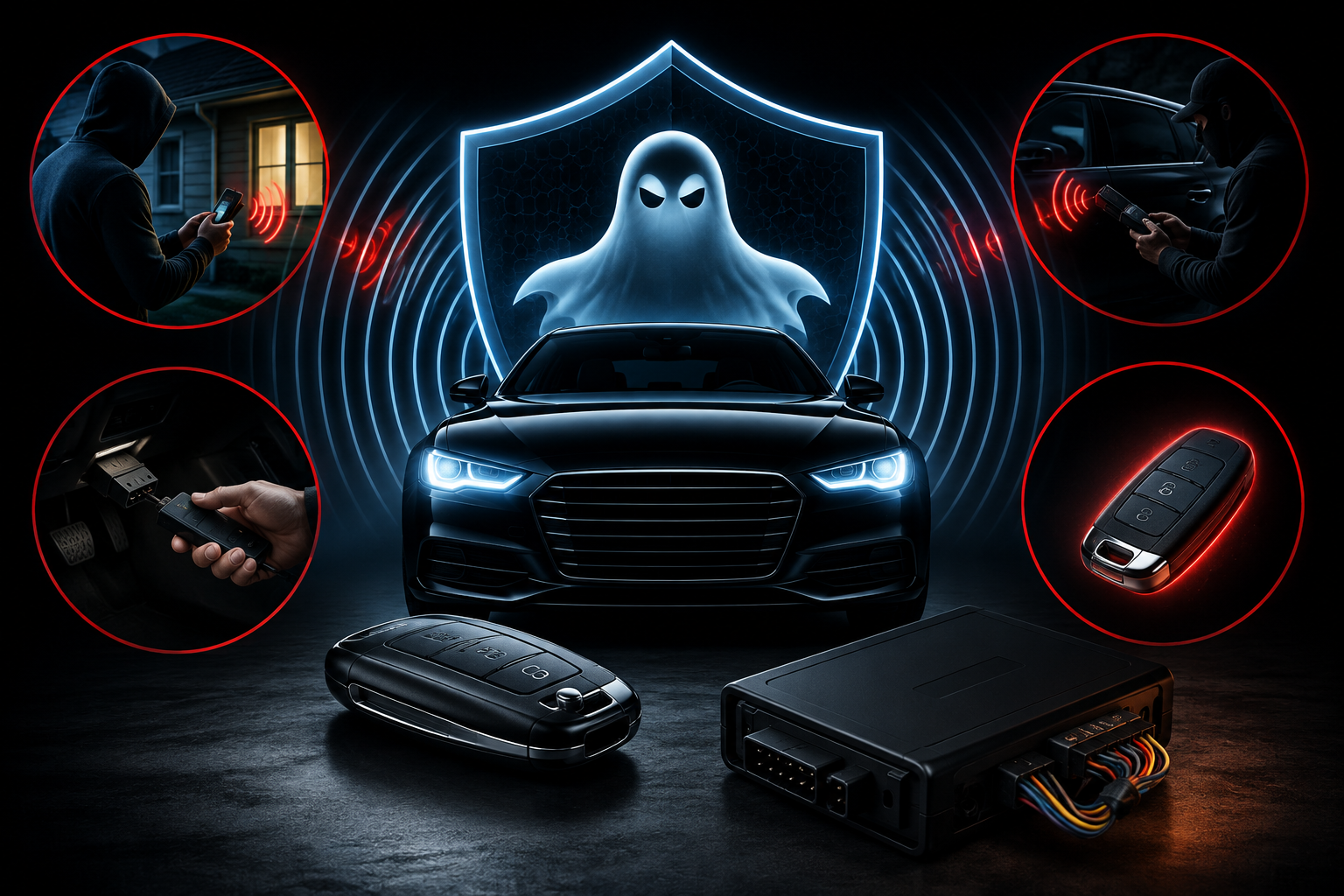
A modern car doesn't need a smashed window to be stolen. Two people, two cheap devices, and about ninety seconds outside a house is often enough — no alarm, no broken glass, nothing for a neighbour to notice until the driveway is empty in the morning. That's relay theft, and it now sits alongside key cloning as the two dominant methods behind the rise in electronic vehicle crime.
They get talked about as though they're the same trick, but they exploit different weaknesses in a car's security — which matters, because a defence against one isn't automatically a defence against the other.
A Ghost Immobiliser is one of the few aftermarket devices that genuinely closes both routes, and it does it for two separate reasons rather than one. This article works through how each attack actually happens, why factory security can't tell a stolen signal from a real one, and how the Ghost II fitted by OJB Autocare stops the engine starting regardless of which method a thief tries.
Key Cloning and
Relay Theft Are
Two Different
Attacks
Product pages tend to fold "key cloning" and "relay theft" into a single sentence, as if a Ghost Immobiliser defeats one generic hacking threat.
In practice they're separate attack chains that happen to arrive at the same result — a car starting for someone who was never issued a key. Understanding the difference is what actually explains why a Ghost Immobiliser stops both, rather than just taking that claim on faith.
How a Relay Attack Works
A relay attack borrows your key's signal rather than copying it. It needs two people and two handheld devices, often bought online for well under £150.
One thief stands close to the house — by the front door, a hallway, sometimes just outside a window — holding a device that picks up the low-power signal a keyless fob constantly gives off, in some cases from more than 100 metres away.
That signal is passed in real time to a second device held by an accomplice standing next to the car. As far as the car is concerned, the key is right there, close enough to unlock the doors and allow a push-button start.
The thief drives away on a borrowed signal, and the key never leaves the hallway table.
The moment the two devices lose contact, the attack stops working — which is exactly why a Faraday pouch, which blocks the fob's signal from leaving the house, defeats it.
How Key Cloning Works
Key cloning doesn't rely on catching a live signal at all, which is why a Faraday pouch does nothing to stop it.
Instead, a thief gets access to the car's electronics — often through the OBD diagnostic port under the dashboard — and uses a programming tool to either read the existing key's data or register a new blank key directly with the vehicle.
Once that's done, the thief is holding a key the car's systems genuinely recognise as valid, indefinitely, not just for the length of a relay session.
This is the method organised gangs increasingly favour for higher-value vehicles, because a cloned key gives them a working key to sell on with the car, not just a one-off theft.
OBD Hacking and CAN
Injection Sit Behind Both
The OBD port and the car's CAN bus network are the common thread.
The same access point used to clone a key can also run a CAN injection attack, sending forged wake-up or unlock commands directly onto the network that connects a car's electronic modules, without touching the key system at all.
Relay theft, key cloning, and CAN injection all end at the same place — an engine-start request the ECU accepts as legitimate — but they get there through three different doors.
Why Factory
Security Can't
Tell a Fake Key
From a Real One
A standard factory immobiliser only asks one question: is the correct key data present?
It has no way to ask how that data arrived.
A relayed signal, a cloned key, and a forged CAN message all present as "correct" to a system built to check for a match, not to check for authenticity.
That's the structural gap every method above exploits, and it's the exact gap a Ghost Immobiliser is designed to sit outside of.
Learn More: Preventing Vehicle Theft vs Recovering a Stolen Vehicle: Ghost Immobiliser or Tracker?
How a Ghost
Immobiliser
Defeats Both
Attacks
It Isn't Part of the
Conversation a Relay Attack
Intercepts
A Ghost Immobiliser doesn't use RF signals and doesn't talk to your key fob at all — it's wired directly into the vehicle's CAN bus.
There's no fob signal for a relay device to capture or amplify in the first place, because starting the engine was never going to depend on that signal reaching the car.
Relay theft has nothing to intercept.
A Cloned Key Still Hits a Wall
the Key System Doesn't
Control
This is the part most explanations of key cloning protection skip past.
A cloned key genuinely will satisfy the car's factory key check — that's what makes it dangerous.
But the Ghost Immobiliser isn't checking the key at all. It sits behind that check as a second, unrelated gate: the engine won't start until your own PIN sequence is entered on buttons already in the car — steering wheel, door panel, or centre console, in whatever order you set.
A thief with a perfect clone still has no PIN, and there's no signal, wire, or fob to reverse-engineer one from.
Nothing Visible to Search For
Because the system uses your car's existing buttons and produces no LED, no keypad, and no RF signal, there's no hardware for a thief to locate even during an unhurried search of the car, and it doesn't show up to standard diagnostic checks used to strip out visible security add-ons.
The Crime and
Policing Act
2026 Changes
the Legal
Picture, Not the
Risk
Relay and cloning tools existed in a genuine legal grey area until this year.
The Crime and Policing Act 2026, which received Royal Assent on 29 April 2026, made it a specific criminal offence to possess, import, manufacture, adapt, or supply devices used to steal vehicles — including relay repeaters, signal amplifiers, jammers, and key emulators.
Previously, police could only act once a device was tied to a specific theft; under the new law, the person found holding one has to prove a legitimate reason for owning it.
Thatcham Research, which has tracked UK vehicle crime for over three decades, credits earlier rounds of security standards with cutting casual theft by roughly 79% from its 1992 peak, but is on record saying today's threat comes from organised, well-resourced criminal groups rather than opportunists.
For a driver, that means the law raises the cost of getting caught with the equipment — it doesn't retire the equipment already in circulation, which is why vehicle-level protection still matters.
Learn More: How ECU Immobilisation Adds Another Layer of Vehicle Protection
Getting a Ghost
Immobiliser
Fitted in
Yorkshire
OJB Autocare fits the genuine Autowatch Ghost II — not an unbranded copy of it — across Leeds, Wakefield, York, Bradford, Hull, Doncaster, and the surrounding towns, with mobile installation at your home, workplace, or our workshop.
Every fitting is carried out by a TASSA-verified engineer, and you set your own PIN sequence before we hand the car back, so it's a code only you know.
Installation starts from £499 depending on your vehicle's make, model, and CAN bus configuration.
Because the Ghost doesn't cut or splice into the car's existing wiring, it doesn't affect warranty cover the way some hard-wired aftermarket alarms can.
Frequently Asked Questions
Does a Ghost Immobiliser Stop a
Cloned Key From Starting My Car?
Yes. A cloned key will pass your car's own factory key check, but the Ghost Immobiliser sits behind that check as a separate step.
The engine still won't start without your unique PIN sequence entered on the vehicle's own buttons, which a cloned key has no way of providing.
Can a Relay Attack Bypass the Ghost
Immobiliser?
No. A relay attack works by extending your key fob's signal to the car, but the Ghost doesn't use or monitor that signal at all — it's wired into the CAN bus instead.
There's no fob communication for a relay device to capture, amplify, or spoof.
Is a Ghost Immobiliser the Same as a
Tracker?
No, they do different jobs.
A Ghost Immobiliser stops the engine starting in the first place, while an S5 or S7 tracker helps locate and recover a vehicle after it's been taken.
Many OJB customers fit both, since one prevents theft and the other backs it up.
Will Fitting a Ghost Immobiliser Affect
My Warranty or Insurance?
It shouldn't affect your manufacturer warranty, since the Ghost connects to the CAN bus without cutting or splicing any existing wiring.
Most insurers recognise TASSA-verified Ghost installations, and some offer a premium reduction — worth confirming with your specific insurer.
How Much Does Ghost Immobiliser
Installation Cost With OJB Autocare?
Installation starts from £499, though the exact price depends on your vehicle's make, model, and CAN bus configuration.
Get in touch with your registration details and we'll confirm an accurate quote along with your nearest mobile fitting slot.
Final Thoughts
Key cloning and relay theft both rely on one thing: your car trusting a key it shouldn't.
A Ghost Immobiliser doesn't try to out-fight either attack on its own terms — it removes the car's dependence on the key signal entirely.