How Criminals Hack Car Key Signals (Relay Attack Explained)
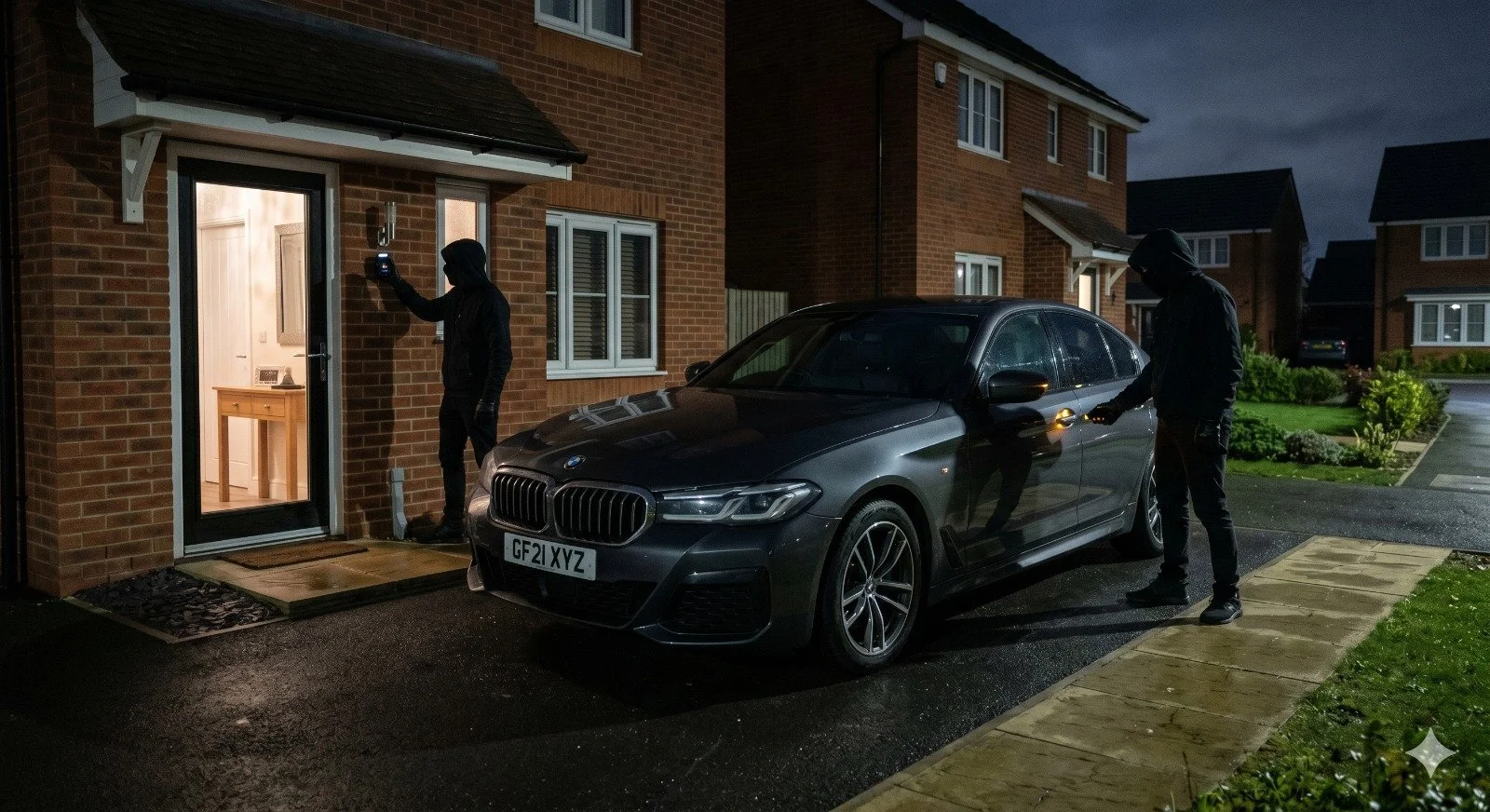
You locked your car. You're sure of it. You even heard the familiar double-beep as you walked away. But the next morning, your car is gone — and there's no broken window, no scratched lock, no sign of forced entry. Just an empty driveway and a sinking feeling in your stomach.
This isn't a movie plot. It's happening on streets across the UK and beyond, and it's called a relay attack. Understanding how it works is the first step to making sure it never happens to you.
What Is a Relay
Attack?
A relay attack is a form of electronic car theft that exploits the technology built into your own key fob.
Modern vehicles use keyless entry systems — also called passive entry or smart key systems. These work by emitting a low-frequency radio signal from your key. When you approach your car, the vehicle detects that signal and unlocks automatically. No button pressing required.
It's incredibly convenient. It's also, unfortunately, a vulnerability that criminals have learned to exploit with alarming efficiency.
In a relay attack, thieves use inexpensive electronic devices to intercept, amplify, and retransmit your key's signal — essentially tricking your car into thinking your key is right next to it, even when you're fast asleep inside your house.
How Criminals
Actually Pull It
Off: A Step-by-
Step Breakdown
Here's where it gets interesting. And a little unsettling.
Step 1: Scout the Target
Thieves typically identify a target vehicle — usually a high-value car with keyless entry — parked outside a home. They know the key fob is likely sitting somewhere inside, just a few metres away. A hallway table. A kitchen counter. A bedside cabinet.
Step 2: Deploy Two Devices
This is a two-person job. One criminal stands near the front of the house with a relay amplifier — a device that can detect and boost the weak RFID signal coming from your key inside the building.
The second person stands near the car with a relay transmitter. Together, these two devices form a bridge: a fake, extended version of the communication channel between your key and your car.
Step 3: Amplify the Signal
Your key fob constantly emits a low-level radio frequency signal. Normally, this signal only reaches a range of a few centimetres — just enough to be detected when you physically approach your car.
The relay amplifier boosts this signal dramatically, extending its range by several metres. It captures the signal through your walls and relays it wirelessly to the transmitter standing next to your car.
Step 4: Unlock and Drive
Away
Your car receives what it believes is a legitimate signal from your key. It unlocks. The engine immobiliser disengages. The thief gets in, presses the start button, and drives away — in complete silence, without triggering any alarm.
The entire process can take less than 60 seconds.
Why Modern
Cars Are So
Vulnerable
Here's the uncomfortable truth: the very features that make today's vehicles so convenient are what make them targets.
Keyless entry and keyless start were designed with comfort in mind. The cybersecurity considerations, particularly around signal amplification attacks, weren't always a primary concern when these systems were first rolled out to mainstream vehicles.
Most smart key systems operate on fixed radio frequencies. They're designed to authenticate based on signal presence, not signal origin. So when that signal is hijacked and retransmitted, the car has no way to tell whether the key is in your hand or being relayed from 20 metres away.
It's not a flaw in a single brand or model. Vehicles from luxury manufacturers to everyday family cars have been demonstrated as vulnerable. Research and real-world theft data have shown that everything from Range Rovers to Volkswagens, BMWs to Toyotas can be compromised using relay attack equipment that costs under £100 to assemble.
A Real-World
Scenario That
Puts It in
Perspective
Imagine Sarah. She's come home after a long day, dropped her keys on the hallway table — right by the front door — and settled in for the evening.
At 2 a.m., two individuals work in near silence on her street. One crouches near her front door. The other stands by her car. Within a minute, her vehicle — a relatively new SUV with all the modern comforts — rolls away without a sound. No alarm. No drama. No trace.
Sarah wakes up the next morning, opens the front door, and stares at an empty space.
This scenario plays out thousands of times every year. And what makes it so frustrating is that Sarah did everything right. She locked her car. She kept her keys safely inside. She just didn't know about relay attacks.
Learn More: Car Theft Methods in Yorkshire: What Every Driver Needs to Know
What You Can
Do Right Now:
Practical
Prevention Tips
The good news? Protecting yourself from relay attacks doesn't require expensive upgrades or complicated technology. Here's what actually works.
Use a Faraday Pouch (Signal-
Blocking Wallet)
A Faraday pouch is a small, inexpensive wallet or case lined with metallic mesh that blocks electromagnetic signals. When your key fob is stored inside one, its signal cannot be detected, amplified, or relayed — full stop.
Store your keys in one every night, and keep a spare pouch near the door for when you come home. It's the single most effective low-cost solution available.
Store Keys Away from the
Front Door
Your hallway is the worst place to keep your keys. The closer they are to the exterior of your home, the easier it is for a relay device to pick up the signal. Move your keys to a central room, an upstairs drawer, or ideally inside a Faraday pouch.
Consider a Steering Wheel
Lock
Old-fashioned? Perhaps. Effective? Absolutely. A visible steering wheel lock is a powerful deterrent. Even if a thief manages to unlock and start your car via a relay attack, a physical barrier means they're not driving anywhere fast. Many thieves will simply move on to an easier target.
Check If Your Key Fob Has a
Sleep Mode
Some manufacturers have introduced key fobs with motion sensors that put the signal into sleep mode when the key hasn't moved for a period of time. Check your vehicle manual or contact your dealer to find out if your key has this feature and how to activate it.
Install a GPS Tracker
A hidden GPS tracker won't prevent theft, but it dramatically improves your chances of recovery and assists law enforcement in locating the vehicle quickly. It's a sensible layer of protection, especially for high-value vehicles.
Ask About Aftermarket
Security Systems
At OJB Autocare, we regularly advise customers on additional vehicle security measures that go beyond factory-fitted systems. From aftermarket immobilisers to tracking solutions and alarm upgrades, layering your security makes your vehicle significantly harder to steal — and less attractive as a target.
What the
Automotive
Industry Is Doing
About It
Manufacturers haven't been sitting still. Newer keyless entry systems are beginning to incorporate ultra-wideband (UWB) technology, which measures the precise distance between the key and the car. Unlike traditional radio frequency signals, UWB is much harder to spoof because it can determine whether the key is actually nearby or being relayed from a distance.
Encrypted rolling codes, signal time-of-flight measurement, and two-factor authentication are also being explored as solutions across the industry.
But these technologies are still rolling out, and millions of existing vehicles remain vulnerable. Until UWB and similar safeguards become universal, owners of keyless entry vehicles need to take personal responsibility for their own protection.
OJB Autocare's
Expert Take
At OJB Autocare, we've seen first-hand how distressing vehicle theft can be — not just the financial loss, but the sense of violation and helplessness that comes with it. Our advice to every customer with a keyless entry vehicle is simple: don't rely on your car's built-in security alone.
Think of vehicle security like a layered system. The more barriers you put between a thief and your car, the less appealing it becomes as a target. Faraday pouches, physical locks, GPS trackers, and professional-grade aftermarket security systems all work together to create a much more robust defence.
Relay attack equipment is cheap and widely available. Your countermeasures don't need to be expensive — but they do need to be consistent.
Learn More: 5 Things to Know Before Installing a GPS Tracker in Your Car
Conclusion:
Stay One Step
Ahead
Relay attacks are a sobering reminder that convenience and security don't always go hand in hand. The same technology that lets you walk up to your car and drive away without fumbling for keys can, in the wrong circumstances, let a stranger do exactly the same thing.
But knowledge is power. Now that you understand how these attacks work, you're already better equipped than the majority of car owners. A Faraday pouch by your door, your keys stored away from windows, and an extra layer of physical security could be all that stands between you and an empty driveway.
If you're unsure about your vehicle's vulnerability or want to explore your security options, the team at OJB Autocare is always happy to help. Protecting your vehicle is what we do — and it starts with a conversation.
Frequently Asked Questions
Q1: What exactly is a relay attack on a
car?
A relay attack is a type of keyless car theft where criminals use electronic devices to intercept and amplify the signal from your key fob inside your home, tricking your car into thinking the key is nearby so it unlocks and starts without any physical key present.
Q2: Which cars are most vulnerable
to relay attacks?
Any vehicle fitted with a keyless entry or keyless start system can potentially be vulnerable. This includes popular models from BMW, Mercedes, Audi, Range Rover, Toyota, Ford, and Volkswagen. It's not limited to luxury cars — if your car unlocks automatically as you approach it, it could be at risk.
Q3: How long does a relay attack take
to execute?
Frighteningly quickly. In most cases, a relay attack can be completed in under 60 seconds. The speed is part of what makes it so effective — there's rarely enough time for anyone to notice or intervene before the vehicle is gone.
Q4: Does a Faraday pouch completely
stop relay attacks?
Yes, when used correctly. A Faraday pouch is lined with signal-blocking metallic mesh that prevents your key fob's radio frequency signal from being detected or amplified. Make sure the pouch is fully sealed around the key and that it carries a verified signal-blocking rating for maximum effectiveness.
Q5: Can relay attacks happen during
the day, not just at night?
Absolutely. While many relay attacks occur at night when keys are left near front doors during sleep, they can happen any time your key is within range of a relay device — including while you're shopping, at work, or even sitting in a cafe with your keys on the table.
Q6: Will a steering wheel lock actually
deter relay attack thieves?
Yes, and more effectively than you might think. Even if criminals successfully unlock and start your car using a relay attack, a visible steering wheel lock creates a physical barrier they can't easily overcome. Most opportunistic thieves will simply move on to an easier target rather than risk the time and noise of dealing with a mechanical lock.
Q7: Is it possible to tell if someone has
attempted a relay attack on my car?
Not always, but there are signs worth noting. If your car unexpectedly unlocks on its own, your key fob seems less responsive than usual, or your vehicle's battery drains faster than normal, these could be indirect indicators. If anything seems off, have your vehicle checked by a professional automotive security specialist.
Q8: Do newer cars come with
protection against relay attacks built
in?
Some do. Manufacturers are increasingly adopting ultra-wideband (UWB) technology, which measures the precise distance between the key and the vehicle to prevent relay spoofing. However, the majority of vehicles currently on the road still use older radio frequency systems that remain vulnerable. Always check with your manufacturer or dealer about your specific model's security features.
Q9: How much does it cost criminals
to carry out a relay attack?
This is one of the most alarming aspects of the threat. Relay attack devices are widely available online and can cost as little as £80 to £100. No specialist technical knowledge is required to operate them, which means the barrier to entry for this type of theft is extremely low.
Q10: What's the single most effective
thing I can do right now to protect my
car from a relay attack?
Purchase a quality Faraday pouch and start using it tonight. Store your keys inside it every time you're at home, and keep it away from exterior walls and doors. It's inexpensive, requires no installation, and immediately eliminates the risk of your key's signal being intercepted. Pair it with a steering wheel lock and you've already put yourself significantly ahead of most car owners when it comes to relay attack protection.