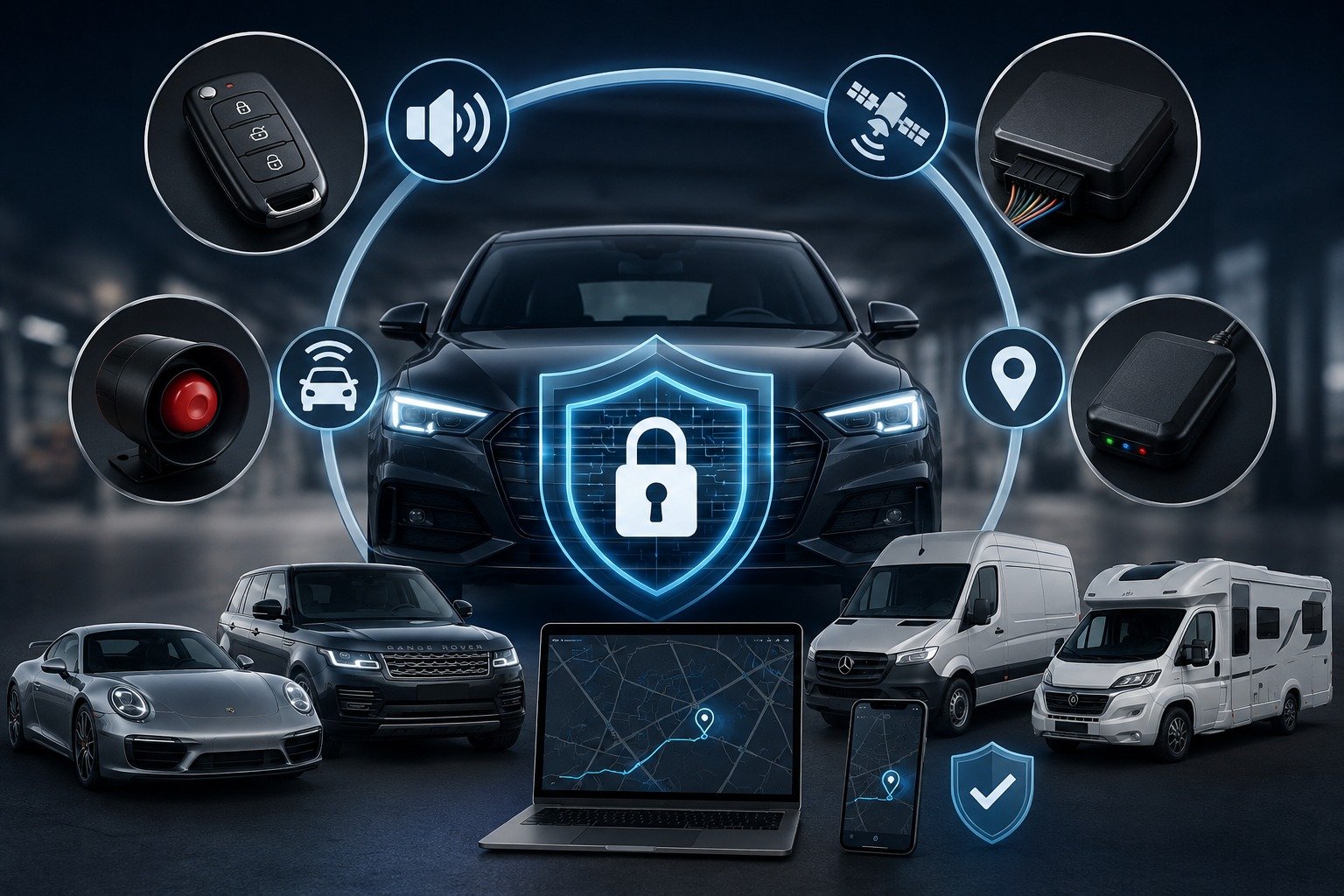
When you start looking at vehicle security, insurance-approved trackers, alarms, immobilisers, and stolen vehicle recovery systems, one name appears again and again: Thatcham.
For many drivers, the terminology can feel like alphabet soup. You may hear people talk about Thatcham S1, S2, S5, S7, Category 1, Category 2, tracker ratings, alarm ratings, and insurance-approved devices. The problem is that not all of those terms are used correctly.
At OJB Autocare, we believe vehicle security should be explained properly, not wrapped in jargon. So, this guide breaks down how Thatcham ratings work, what each major category means, and how to choose the right level of protection for your vehicle.
A quick but important note: people often search for “S1” and “S2”, but the official Thatcham terms for alarm and immobiliser systems are usually Category 1 and Category 2. The “S” categories are mainly used for tracking and stolen vehicle recovery systems, such as S5 and S7. Thatcham’s own listing separates Category 1, Category 2, Category S5 and Category S7 as different security product categories.
What Is a
Thatcham
Rating?
A Thatcham rating is a security classification used to show that a vehicle security product has been tested against recognised criteria. These ratings are commonly associated with alarms, immobilisers, trackers, asset location systems, wheel locking devices, and other vehicle protection products.
Thatcham Research describes its Security Certification as a verification programme for automotive security products, focused on assessing a product’s functionality, design, and performance. Certified products are tested against predefined criteria and listed in Thatcham’s security certification database.
In plain English, a Thatcham-approved product has not simply been labelled “secure” by the manufacturer. It has been assessed against a recognised standard.
That matters because vehicle theft has changed. Older theft methods were often physical: forced doors, smashed windows, hot-wiring, or stolen keys. Modern theft can involve relay attacks, key cloning, signal interception, OBD port access, and electronic manipulation. A proper security system needs to do more than make noise when a door opens.
Why Thatcham
Ratings Matter
for Vehicle
Owners
Thatcham ratings are important because they help drivers, installers, and insurers understand what a security product is designed to do.
For vehicle owners, the main benefits are:
Clearer product comparison between alarms, immobilisers, and trackers
Better insurance conversations, especially when an insurer asks for a specific security category
Improved theft protection when the right product is installed correctly
Greater confidence that the system has been assessed against recognised criteria
Better stolen vehicle recovery support when choosing a monitored tracker
However, there is one key point many people miss: Thatcham certification does not automatically guarantee that every insurer will accept a product. Thatcham states that insurer recognition is negotiated individually by the product manufacturer and insurer partners.
That means you should always check with your insurer before buying a tracker, alarm, or immobiliser to satisfy a policy requirement. It is not glamorous advice, but it can save you an expensive headache.
S1 and S2
Explained: What
People Usually
Mean
Although many drivers search for Thatcham S1 and Thatcham S2, the more accurate terms are generally Thatcham Category 1 and Thatcham Category 2.
This distinction matters because Category 1 and Category 2 relate to alarms and immobilisers, while S5 and S7 relate to tracking and stolen vehicle recovery systems.
So, when someone says “S1” or “S2”, they are usually referring to:
Category 1: Alarm and immobiliser combined
Category 2: Immobiliser only
Let’s break those down properly.
Thatcham
Category 1:
Alarm and
Immobiliser
Combined
A Thatcham Category 1 system combines an alarm and an immobiliser. It is designed to help protect the vehicle before and during a theft attempt.
The alarm side helps detect interference, such as unauthorised entry or movement inside the vehicle. The immobiliser side helps prevent the vehicle from being started or driven away without authorisation.
Thatcham’s vehicle security listing describes Category 1 as a combined alarm and immobiliser system. Key features include full perimetric and volumetric alarm detection, a battery-backed siren, an immobiliser that isolates a minimum of two operating systems, passive arming, and anti-scan/anti-grab resistance of key codes.
What Category 1 Is Best For
Category 1 is often suitable for drivers who want a strong alarm and immobilisation package. It is especially useful for vehicles that may not already have a strong factory-fitted security system.
It can be relevant for:
Older vehicles with limited factory security
Imported vehicles
Modified or performance vehicles
Vehicles kept outside overnight
Cars where an insurer asks for an approved alarm and immobiliser
A Category 1 system is not the same as a tracker. It is designed to deter theft and prevent unauthorised starting, but it does not necessarily help locate the vehicle after it has been stolen.
Thatcham
Category 2:
Immobiliser
Protection
A Thatcham Category 2 system is an immobiliser-only security product. It does not include a full alarm system.
The purpose of an immobiliser is simple: stop the vehicle from being started or driven without the correct authorisation. This may involve isolating essential circuits or systems needed for the vehicle to run.
Thatcham’s listing describes Category 2 as an electronic or electromechanical immobiliser, with key features including immobilisation of a minimum of two operating systems, passive arming, and resistance against code scanning or grabbing.
What Category 2 Is Best For
Category 2 is often relevant when a vehicle needs immobilisation but not necessarily a full alarm system.
It can be useful for:
Vehicles without a strong immobiliser
Older vehicles
Some light commercial vehicles
Cars where theft prevention is the main concern
Drivers looking for a simpler security upgrade
A Category 2 immobiliser can help stop a thief from driving the vehicle away, but because it does not include a full alarm, it may not alert people nearby if someone breaks into the vehicle.
Category 2-1:
The Upgrade
Route Many
People Miss
There is also a Category 2-1 classification. This is where a vehicle that already has a Category 2 immobiliser is upgraded with an approved alarm system to bring the overall security closer to Category 1 status.
Thatcham describes Category 2-1 as an alarm upgrade for a vehicle already fitted with a Category 2 immobilisation system.
This can be useful if your vehicle already has an immobiliser but your insurer wants a stronger alarm-based security setup.
Thatcham S5
Explained: High-
Level Vehicle
Tracking
Thatcham Category S5 is one of the main modern tracker categories. It is designed for vehicle tracking and stolen vehicle recovery.
S5 replaced older tracker classifications from January 2019, including previous Category 5 and some Category 6 systems. Thatcham defines S5 Vehicle Tracking Systems as systems intended to detect unauthorised use of a protected vehicle and increase the probability of recovering a stolen vehicle.
A typical S5 tracker is more advanced than a basic tracking unit. Thatcham’s minimum feature list for S5 includes 24/7 monitoring, GPS, driver identification, vehicle motion detection, data logging, bidirectional data transmission, battery backup, a health check programme, and resistance to attack for a minimum period.
The Big Difference: Driver
Identification
The standout feature of S5 is driver identification.
In practical terms, this usually means the authorised driver carries an ID tag, card, or approved identification method. If the vehicle moves without the recognised driver ID present, the system can treat this as suspicious and trigger an alert.
That is particularly useful in cases where a thief has the key but not the driver ID tag. With modern key theft and relay attacks, that extra step can make a real difference.
What S5 Is Best For
S5 is commonly recommended for:
High-value vehicles
Prestige cars
Performance cars
SUVs targeted by thieves
Vehicles with keyless entry
Insurance-mandated tracker installations
Owners who want stronger stolen vehicle recovery support
If your insurer has specifically asked for an S5 tracker, do not assume an S7 tracker will be accepted. They are not the same thing.
Learn More: What Makes a Car “High Theft Risk” in 2026? OJB Autocare UK Guide
Thatcham S7
Explained: Asset
Location and
Recovery
Thatcham Category S7 is another tracker-related category, but it is usually seen as a more straightforward level of stolen vehicle or asset location protection compared with S5.
Thatcham defines S7 as an Asset Location System. Like S5, it replaced older tracker classifications from January 2019, including previous Category 6 or 7 systems. The stated purpose of an S7 system is to increase the probability of recovering a stolen asset.
S7 systems must include features such as 24/7 monitoring, passive and remote set functions, health checks, a means of locating the asset, at least one means of signal transmission, battery backup, and resistance to attack for a minimum period.
What S7 Is Best For
S7 can be a good choice for drivers who want monitored tracking but do not necessarily need the higher-level features of S5.
It may suit:
Everyday vehicles
Vans and light commercial vehicles
Motorhomes
Lower-risk vehicles
Vehicles where the insurer asks for S7 specifically
Owners who want recovery support without paying for the highest tracker category
S7 still provides valuable tracking and recovery support, but it generally does not offer the same level of driver recognition functionality associated with S5.
S5 vs S7: What Is
the Difference?
The main difference between S5 and S7 trackers is the level of security and driver identification. S5 trackers include driver recognition and are commonly recommended for high-value or higher-risk vehicles, while S7 trackers focus on vehicle tracking and stolen vehicle recovery for everyday cars, vans, and motorhomes. The right choice depends on your vehicle, level of risk, and insurer requirements, as choosing the correct system helps balance both security and cost.
Do Thatcham
Trackers Reduce
Insurance
Costs?
Sometimes, but not always.
A Thatcham-approved tracker may help with insurance, especially if the insurer requires it as a condition of cover. In some cases, it may help reduce a premium. In other cases, it may simply allow the insurer to provide theft cover on a higher-risk vehicle.
The important point is that insurance decisions are made by insurers, not by the installer. Thatcham also makes clear that certification itself does not guarantee insurer recognition.
Before installing a tracker for insurance purposes, ask your insurer:
Do you require S5 or S7?
Does the tracker need 24/7 monitoring?
Does it need driver identification?
Do you require proof of installation?
Are there specific approved brands or monitoring centres?
Will the installation affect my premium or simply satisfy the policy requirement?
That five-minute conversation can prevent a lot of back-and-forth later.
Why
Professional
Installation
Matters
A Thatcham-approved product still needs to be fitted correctly. Poor installation can cause unreliable alerts, weak signal performance, wiring issues, battery drain, or obvious device placement.
With trackers, discreet installation is especially important. If the device is easy to find, it is easier to attack, remove, or disable. With immobilisers and alarms, correct wiring and integration are essential for reliability.
At OJB Autocare, the focus is on practical, vehicle-specific security advice. The right solution should suit the vehicle, the owner’s risk level, and any insurance requirements. Security should not be guesswork, and it definitely should not be a rushed job behind the dashboard with a roll of tape and wishful thinking.
Which Thatcham
Rating Do You
Need?
The right Thatcham category depends on what problem you are trying to solve.
If you want to stop the vehicle being started, you may be looking at an immobiliser-style solution.
If you want an audible warning and immobilisation, Category 1-style protection is more relevant.
If you want stolen vehicle recovery support, you are looking at S5 or S7 tracking.
If your insurer has made a specific request, that request should lead the decision. For example:
“Must have a Thatcham S5 tracker” means you should look at S5, not S7.
“Must have a tracker” needs clarification because S5 and S7 are different.
“Must have Thatcham Category 1 alarm” does not mean a tracker alone is enough.
“Must have immobiliser” may refer to Category 2 or another insurer-recognised immobiliser.
The best approach is to get the exact wording from your insurer, then choose the product and installation route accordingly.
Common
Mistakes Drivers
Make With
Thatcham
Ratings
One of the biggest mistakes is assuming all trackers are the same. They are not. A cheap GPS tracker bought online may show a location on an app, but that does not mean it is Thatcham-approved, insurance-approved, monitored, or suitable for stolen vehicle recovery.
Another mistake is confusing alarms, immobilisers, and trackers. They are related, but they do different jobs.
An alarm helps detect and warn.
An immobiliser helps prevent the vehicle from being driven.
A tracker helps locate and recover the vehicle after unauthorised movement or theft.
The strongest security setups often use layers. A tracker is useful, but it is even better when combined with good physical security, sensible parking habits, strong key protection, and proper immobilisation.
Learn More: Is It Legal to Track Your Own Car in the UK?
How OJB
Autocare Can
Help
At OJB Autocare, we help drivers make sense of vehicle security without the sales fog. Whether you are trying to understand an insurance requirement, compare S5 and S7 trackers, or decide whether your vehicle needs an alarm, immobiliser, or tracking system, the goal is to recommend the right solution rather than the most complicated one.
Vehicle security is not about ticking a box. It is about protecting your car, van, tools, livelihood, and peace of mind.
If you are unsure whether you need Category 1, Category 2, S5, or S7, OJB Autocare can help you understand the differences and choose a security setup that makes sense for your vehicle. See our S5 and S7 tracker installation service for fitting options.
FAQs About Thatcham
Ratings
1. What does Thatcham-approved
mean?
Thatcham-approved means a vehicle security product has been assessed against recognised criteria for functionality, design, and performance. These products are listed within Thatcham’s security certification database, although insurer acceptance can still vary depending on the product and insurer.
2. Is Thatcham S1 the same as
Category 1?
In most cases, when people say “S1”, they usually mean Thatcham Category 1. Officially, Category 1 refers to a combined alarm and immobiliser system. The “S” prefix is more commonly associated with tracker categories such as S5 and S7.
3. Is Thatcham S2 the same as
Category 2?
Usually, yes. People often use “S2” casually, but the official term is generally Thatcham Category 2. Category 2 refers to an electronic or electromechanical immobiliser.
4. What is the difference between
Category 1 and Category 2?
Category 1 combines an alarm and immobiliser. Category 2 is immobiliser-only. In simple terms, Category 1 helps detect intrusion and prevent theft, while Category 2 focuses on stopping the vehicle from being started or driven without authorisation.
5. What is a Thatcham S5 tracker?
A Thatcham S5 tracker is a higher-level vehicle tracking system designed to detect unauthorised vehicle use and improve the chance of stolen vehicle recovery. S5 systems include features such as 24/7 monitoring, GPS, driver identification, motion detection, data logging, and battery backup.
6. What is a Thatcham S7 tracker?
A Thatcham S7 tracker is an asset location system designed to improve the chance of recovering a stolen vehicle or asset. It usually provides monitored location and recovery support but does not typically offer the same driver identification level associated with S5.
7. Is S5 better than S7?
S5 offers a higher level of protection, mainly because it includes driver identification within the Thatcham feature set. S7 can still be suitable for many vehicles, but S5 is often preferred for high-value, high-risk, or insurer-mandated installations.
8. Which Thatcham tracker does my
insurer need?
You need to ask your insurer directly. Some insurers require S5, while others may accept S7. The exact requirement can depend on the vehicle’s value, theft risk, postcode, usage, and policy terms.
9. Does a Thatcham tracker stop a car
from being stolen?
A tracker does not usually stop the theft from happening by itself. Its main job is to help detect unauthorised use and support vehicle recovery. For theft prevention, trackers are often combined with immobilisers, alarms, steering locks, driveway posts, Faraday pouches, and other security measures.
10. Can OJB Autocare help me choose
the right Thatcham-rated security
system?
Yes. OJB Autocare can help you understand the difference between Category 1, Category 2, S5, and S7 so you can choose the right security option for your vehicle, insurance requirements, and budget.