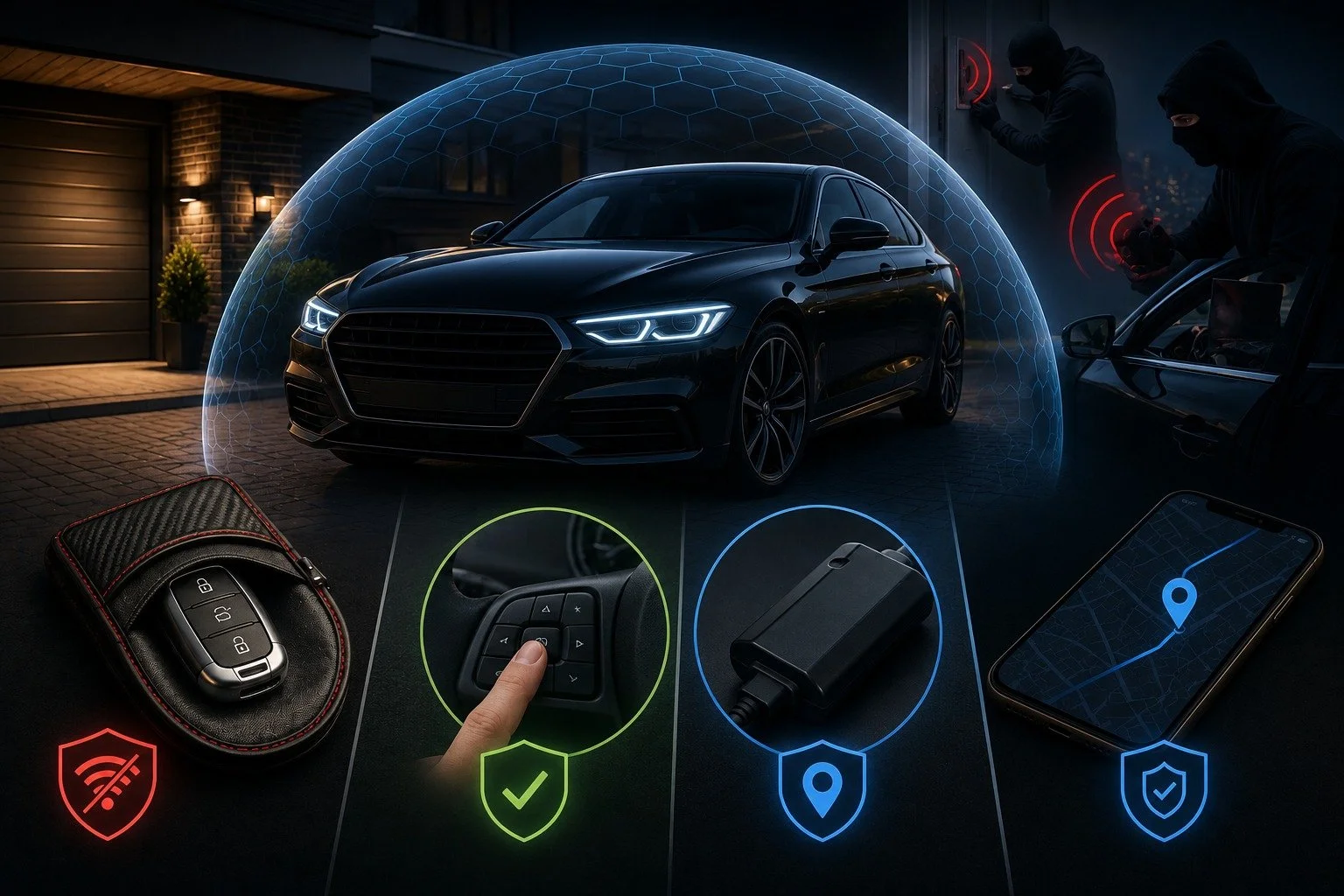
If you drive a car with keyless entry, you're carrying around more convenience than any driver a generation ago — and, unfortunately, more risk too. Keyless cars start with the press of a button as long as the fob is somewhere nearby. That same feature is exactly what organised theft gangs have learned to exploit, usually from outside your front door while you're asleep.
At OJB Autocare, we've fitted enough security systems on enough keyless vehicles to know this isn't a problem you solve with a single gadget. It's a problem you solve with layers. This guide walks through how keyless theft actually happens, which security technologies genuinely stop it, and how to put together a setup that matches your car, your budget, and your insurer's requirements.
How Keyless Car
Theft Actually
Works
Before choosing any security device, it helps to understand what you're defending against. Most keyless theft today isn't smash-and-grab opportunism — it's a quiet, calculated process that leaves no broken glass and no obvious sign anything happened.
Relay Attacks
A relay attack is the most common method used against keyless entry vehicles. Your key fob is constantly emitting a low-power signal, waiting for your car to come within range. Thieves exploit this by working in pairs: one person stands near your house with a signal amplifier to capture the fob's signal — even through a wall or window — while a second person stands next to your car with a receiving device. The car is tricked into believing the genuine key is right beside it, the doors unlock, and the engine starts. The entire process typically takes under a minute and requires no physical contact with your keys at all.
Key Cloning
Some thieves use signal-grabbing or diagnostic tools to clone the data from your fob, effectively creating a duplicate key without you ever knowing your original was compromised.
CAN-Bus Injection
("Headlight Hacking")
A newer and more concerning method involves accessing your vehicle's CAN-bus — the internal network that lets every component in your car talk to the engine control unit — through external wiring such as a headlight cluster. By plugging directly into this network, thieves can send a signal that tricks the car into thinking a valid key is present, bypassing the keyless system entirely without ever touching your fob.
Why Factory Security Often
Falls Short
Original equipment immobilisers and alarms were designed for an earlier generation of theft tactics — physical break-ins and hot-wiring. They weren't built to recognise a relayed signal or an injected CAN-bus command as fraudulent, because to the car's computer, it looks exactly like a legitimate key. This is the gap that aftermarket vehicle security exists to close.
What "Best"
Actually Means
for Keyless
Vehicle Security
There's no single device that solves every threat on this list. The strongest setups combine prevention (stopping the engine from starting at all) with recovery (locating and recovering the vehicle if it's physically moved, such as on a tow truck or low-loader). Here's how the main technologies stack up.
Ghost Immobilisers
A Ghost-style immobiliser is a small, covert device wired directly into your vehicle's CAN-bus network. Rather than relying on a fob, radio signal, or visible keypad, it requires you to enter a unique PIN sequence using buttons already on your steering wheel or dashboard before the engine will start.
This approach has a few distinct advantages:
No radio frequency signal — there's nothing for a relay attack or signal scanner to intercept, because the device never broadcasts anything.
No visible components — there's no fob, no flashing LED, and nothing for a thief searching the car to find.
Defeats key cloning — even with a perfectly cloned key or your actual stolen key in hand, the engine won't start without the correct button sequence.
The trade-off is that a covert immobiliser is purely preventative. It stops the engine from starting, but it offers no way to locate your car if it's removed by other means — which is where tracking systems come in.
Thatcham-Approved GPS
Trackers (S5 and S7)
GPS trackers add the recovery layer that an immobiliser can't provide on its own. Thatcham-categorised trackers are independently assessed against strict performance standards, and many UK insurers specifically require an S5 or S7-rated tracker as a condition of cover for high-value or high-theft-risk vehicles.
S5 trackers typically include driver recognition tags, alerting a monitoring centre if the vehicle moves without an authorised tag present.
S7 trackers combine GPS tracking with an additional layer, often including remote immobilisation capability once the vehicle has come to a stop, supported by a 24-hour monitoring centre that can liaise with police and recovery services.
A tracker won't stop a thief from getting into your car, but it dramatically improves the odds of getting your vehicle back if prevention measures are bypassed or the car is taken on a flatbed.
Learn More: How Thatcham Ratings Work: S1, S2, S5 and S7 Explained
Combining Both: The
Layered Defence
The pairing that comes up again and again among security specialists is a covert immobiliser plus a Thatcham-approved tracker. The logic is straightforward: the immobiliser stops the engine from starting under normal circumstances, while the tracker provides a backup plan if the vehicle is physically removed without the engine ever running. Bundling both during a single installation is also typically more cost-effective than booking separate appointments, since one engineer can fit and certify everything in one visit. Compare Ghost and tracker packages and ask for a fitted package quote.
Faraday Pouches and Signal-
Blocking Boxes
A Faraday pouch is a signal-blocking bag that you store your fob inside to prevent it from broadcasting its signal where a relay device could pick it up. It's an affordable, accessible first step — but it has a meaningful limitation: it only works if you remember to use it every single time. One forgotten night, one fob left on the hallway table instead of in the pouch, and the protection it offers disappears completely. We'd recommend treating a Faraday pouch as a helpful habit, not a security system in its own right.
Steering Wheel Locks and
Visible Deterrents
Old-fashioned, highly visible deterrents still earn their place. A steering wheel lock, a driveway post, or simply parking inside a garage won't stop a determined professional thief, but it adds friction and visibility that pushes opportunistic thieves toward an easier target. Combined with digital protection, visible deterrents are a sensible, low-cost addition rather than a replacement for proper immobilisation.
Next-Generation Factory
Solutions: UWB and Motion-
Sensor Keys
Some newer vehicles now come fitted with Ultra-Wideband (UWB) key technology, which can measure the precise distance between the fob and the car, refusing to unlock if the key is too far away — even if a relay signal is present. Other manufacturers are introducing motion-sensor fobs that stop transmitting if left stationary for a few minutes. These are genuine improvements, but they're not yet universal across all makes and models, and they shouldn't be assumed to be foolproof. If your car has either feature, it's a welcome extra layer — not a reason to skip aftermarket protection.
Choosing the
Right Setup for
Your Vehicle
The right combination depends on a few practical factors:
Vehicle value and theft risk — higher-value and frequently targeted models generally warrant a covert immobiliser paired with a tracker, rather than relying on either alone.
Insurance requirements — always check your policy schedule directly. Many insurers now name a specific Thatcham category (such as S5 or S7) as a condition of cover, particularly for keyless models.
Installer credentials — fitment quality genuinely affects both your security and your insurance validity. Look for certified, experienced installers rather than anyone offering the cheapest possible fit.
Daily usage habits — if you frequently let other drivers, valets, or garages use the car, ask about service or valet modes that allow temporary use without your personal PIN sequence.
At OJB Autocare, we assess each vehicle and each driver's situation individually rather than recommending a one-size-fits-all package. A city runabout and a high-value SUV parked on an open driveway don't carry the same risk profile, and your security setup shouldn't pretend otherwise.
Learn More: What Makes a Car “High Theft Risk” in 2026? OJB Autocare UK Guide
Final Thoughts
Keyless convenience isn't going away, and neither is the theft activity that has grown around it. The good news is that the technology to counter it has matured just as quickly. A covert immobiliser stops the engine from starting in the first place. A Thatcham-approved tracker gives you a recovery path if it doesn't. Faraday pouches, visible deterrents, and manufacturer updates all add useful friction on top. None of these need to be chosen in isolation — the strongest protection comes from layering them together, fitted properly, and matched to how you actually use your car.
If you'd like a clear, no-pressure recommendation for your specific vehicle, the team at OJB Autocare is happy to talk you through the options and what your insurer is likely to expect.
Frequently Asked Questions
1. What is a relay attack and how does
it target keyless cars?
A relay attack uses two connected devices to capture the signal from your key fob — even through walls — and beam it to your car, tricking it into thinking the key is right beside it. This lets thieves unlock and start the engine without ever touching your actual keys.
2. Can a Faraday pouch alone fully
protect my keyless car from theft?
No. A Faraday pouch blocks your fob's signal while it's inside the pouch, but it only works if you remember to use it consistently. It's a useful habit alongside other protection, not a standalone security system.
3. Is a Ghost immobiliser Thatcham
approved?
Covert immobilisers like the Ghost typically sit outside Thatcham's traditional testing categories, since they work differently from conventional alarms and trackers. Many insurers still recognise them as effective theft deterrents, but if your policy specifically requires a Thatcham-approved device, that usually refers to a GPS tracking system rated S5 or S7.
4. Do I still need a tracker if I already
have a covert immobiliser fitted?
A covert immobiliser is excellent at stopping your engine from starting, but it can't help if a thief removes your car physically, such as by towing it on a low-loader. A tracker adds that recovery layer, which is why the two are usually recommended together.
5. What does CAN-bus injection or
"headlight hacking" mean?
It's a method where thieves access your car's internal CAN-bus network through external wiring, such as a headlight cluster, to send a signal that mimics a valid key — bypassing the keyless system without needing your actual fob.
6. Will fitting aftermarket security
void my car's warranty?
Not if it's installed correctly by a certified, experienced installer who understands your vehicle's electrical systems. Poor-quality or amateur fitting is what typically causes warranty issues, which is why installer credentials matter as much as the device itself.
7. What's the difference between an
S5 and S7 Thatcham-rated tracker?
Both provide GPS tracking and 24-hour monitoring, but S7-rated systems generally add further capability, such as remote immobilisation once the vehicle has stopped, alongside the live tracking and driver recognition features common to S5 systems.
8. Does my insurance company
require a specific type of security
device?
It depends on your insurer and your vehicle. Many policies for high-value or keyless-entry cars now name a required Thatcham category directly in the policy schedule, so it's worth checking with your insurer before choosing a device.
9. Can newer keyless technology like
UWB fobs replace the need for
aftermarket security?
Ultra-Wideband and motion-sensor fobs are a genuine improvement and make relay attacks harder to pull off, but they're not available on every vehicle and shouldn't be treated as a complete solution on their own. Aftermarket protection still adds meaningful value, especially on older or high-risk models.
10. How does OJB Autocare decide
which security setup is right for my
car?
We look at your specific vehicle, its theft risk, your insurance requirements, and how you actually use the car day to day, then recommend a setup — whether that's an immobiliser alone, a tracker alone, or both together — rather than pushing the same package to every customer.