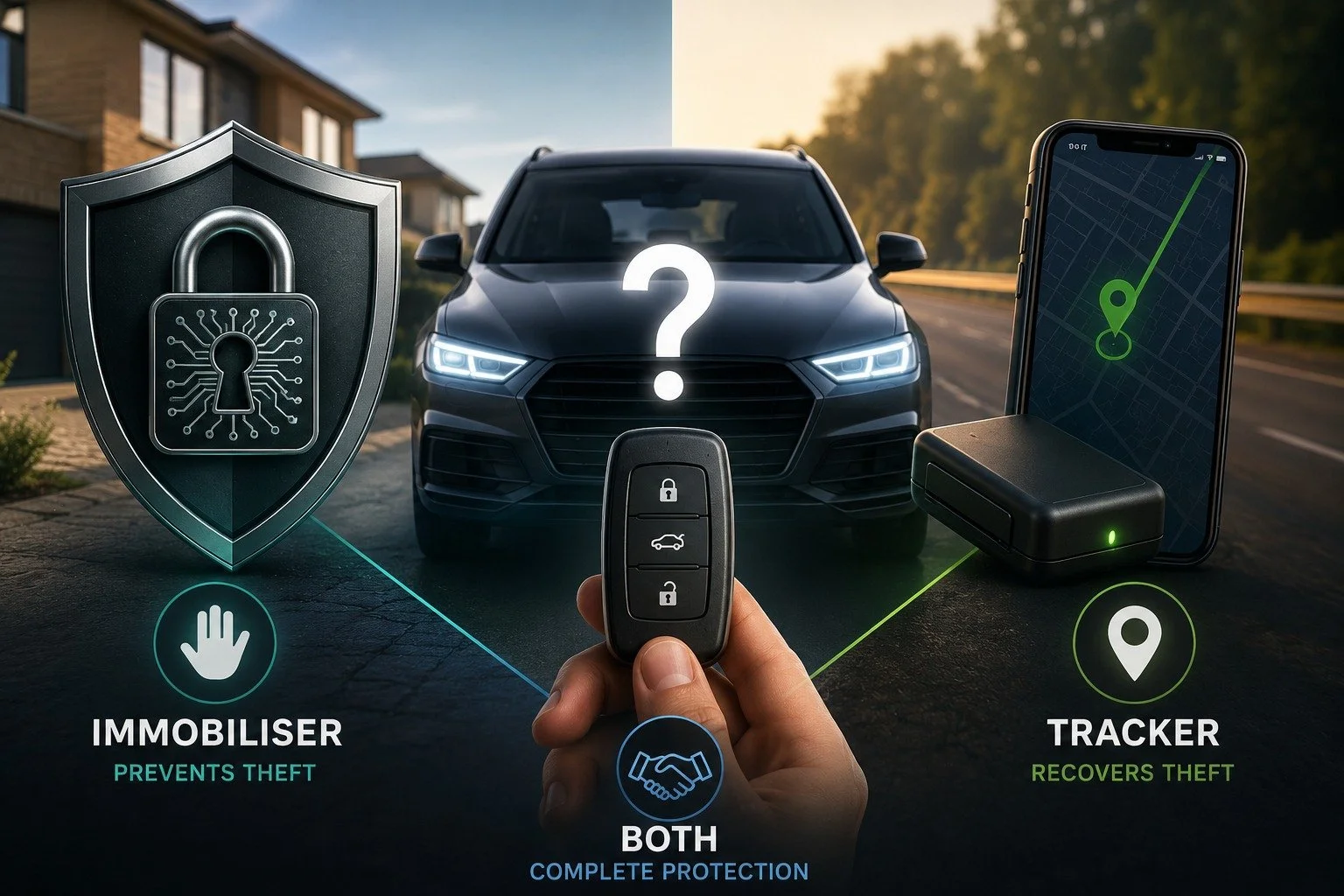
If you've started looking into vehicle security, you've probably noticed that "tracker" and "immobiliser" get used almost interchangeably — as if they're the same thing wearing different names. They're not. They solve different problems, sit at different points in the theft timeline, and in most cases, they're meant to work together rather than instead of each other.
At OJB Autocare, this is one of the questions we get asked more than almost any other: do I actually need both, or is one enough? The honest answer depends on your vehicle, how it's most likely to be stolen, and what your insurer expects from you. Below, we'll break down exactly what each device does, where the real-world gaps are, and how to decide what's right for your car.
What Is a Vehicle
Immobiliser?
An immobiliser is a security device that prevents your engine from starting unless it recognises an authorised key, fob, or token. Think of it as the gatekeeper at the ignition — no valid signal, no engine start, full stop.
Modern vehicles typically come with a factory-fitted immobiliser as standard, usually a transponder chip embedded in the key that communicates with the engine control unit (ECU). The problem is that thieves have caught up. Techniques like key cloning, relay attacks, and OBD port hacking (plugging a device into the onboard diagnostics port to programme a blank key) can bypass factory immobilisers in under a minute on many makes and models.
This is where an aftermarket immobiliser, such as a Ghost Immobiliser, changes the equation. Rather than relying on a key signal that can be intercepted or cloned, systems like this require a unique PIN code entered using the vehicle's existing buttons (steering wheel controls, infotainment buttons, etc.) before the car will drive. There's no fob, no additional key, and no extra wiring loom for thieves to locate and bypass — which is exactly why insurers and police-endorsed schemes like Thatcham Research and Secured by Design favour this category of device.
In short: an immobiliser stops the theft before it starts. It's a prevention tool, not a recovery tool.
What Is a Vehicle
Tracker?
A tracker is a GPS- or GSM-based device fitted to your vehicle that allows it to be located in real time — usually monitored by you via an app, and in the case of professionally monitored systems, by a 24/7 Secure Operating Centre (SOC).
Trackers don't stop a vehicle from being stolen. Their entire job starts after the theft has already happened. Once a vehicle moves without authorisation, the system flags unusual movement, alerts the monitoring centre or owner, and provides live location data so the vehicle can be recovered — often before it's stripped, exported, or sold on.
There are a few common tiers worth knowing:
Self-monitored GPS trackers – You get the alert and location data; you (or the police, once notified) act on it.
Professionally monitored trackers – A SOC verifies the alert and works directly with police to coordinate recovery, which tends to produce faster, more reliable outcomes.
S5/S7-rated trackers – Insurance-approved categories, often required for higher-value or higher-risk vehicles as a condition of cover.
In short: a tracker doesn't stop a theft. It dramatically increases the odds of getting your vehicle back if one happens anyway.
Learn More: What to Do If Your Car Gets Stolen in the UK
The Real
Difference:
Prevention vs.
Recovery
The biggest difference between a vehicle immobiliser and a tracker comes down to when each system steps in to protect your vehicle.
A vehicle immobiliser is designed to prevent theft from happening at all. It stops the engine from starting unless the correct authentication process is completed, making it highly effective against relay attacks, key cloning, and other forms of keyless vehicle theft. Its purpose is simple: stop criminals from driving the vehicle away in the first place.
A vehicle tracker serves a different role. Rather than preventing theft, it helps locate and recover a vehicle after it has been stolen. Trackers use GPS and communication technology to provide location data, which can assist recovery teams and law enforcement in finding the vehicle.
This is why comparing an immobiliser and a tracker as if they perform the same job can be misleading. They address different stages of the theft process. An immobiliser focuses on prevention before a theft occurs, while a tracker focuses on recovery after a theft has taken place.
For drivers concerned about relay attacks, keyless entry vulnerabilities, or key cloning, an immobiliser is often the first line of defence. For owners of high-value vehicles that may be targeted by organised theft groups or export criminals, a tracker can provide valuable recovery capabilities if the worst happens.
Ultimately, the question isn't which device is better. The real question is whether your priority is stopping the theft from happening or improving the chances of recovering the vehicle afterwards. Many vehicle owners choose to use both systems together for the highest level of protection.
So, Which One
Do You Actually
Need?
You may only need an
immobiliser if:
Your main concern is keyless theft, relay attacks, or key cloning
You park in a relatively low-risk area with low rates of vehicle export theft
You want a one-time investment with no ongoing subscription
Your insurer doesn't mandate tracker-specific cover
You may need a tracker (in
addition to an immobiliser) if:
You drive a high-value, high-theft-risk model (certain 4x4s, performance cars, and vehicles frequently targeted for export)
Your insurance policy specifically requires an S5 or S7-rated tracker as a condition of cover
You want active recovery support, not just theft prevention
You've previously had a vehicle stolen or attempted
Why most security
professionals recommend
both:
An immobiliser without a tracker still leaves a gap: if a thief manages to bypass it through more sophisticated means (full key theft, for example, where they've obtained your actual keys), there's no recovery layer behind it. A tracker without an immobiliser means there's nothing actually stopping the theft from happening in the first place — you're relying entirely on a recovery operation after the fact.
Used together, you get layered protection: the immobiliser raises the difficulty and time required to steal the vehicle at all, and the tracker gives you a fallback if a determined thief gets past that first layer. This is precisely the model used in most insurer-approved, Thatcham-categorised security setups for higher-risk vehicles.
What This Means
for Insurance
Many UK insurers now ask specific questions about vehicle security at quote stage, and some high-risk vehicle categories won't be insurable — or will only be insurable at a much higher premium — without an approved tracker, immobiliser, or both. If your insurer has specified a device category (commonly referencing Thatcham Category S5, S7, or similar), it's worth confirming exactly which one your policy requires before purchasing anything, since not all devices on the market meet insurer specifications.
Learn More: Ghost immobiliser vs vehicle tracker
Getting the Right
Setup for Your
Vehicle
At OJB Autocare, we help you choose equipment for your vehicle and insurer requirements. We fit Autowatch Ghost-II immobilisers and Scorpion S5 and S7 trackers, with Ghost package options. Ghost has no subscription charge; tracker monitoring requires a separate subscription. Ask us to check compatibility and provide a package quote.
If you're not sure which category your car falls into, or what your insurer is actually asking for, get in touch with our team and we'll talk it through properly before you spend a penny on the wrong device.
Frequently Asked Questions
1. What's the main difference between
a tracker and an immobiliser?
An immobiliser prevents your vehicle's engine from starting unless an authorised PIN or key signal is given, stopping theft before it begins. A tracker, on the other hand, locates your vehicle after it's been stolen using GPS or GSM signals. One is prevention, the other is recovery — most vehicles benefit from having both working together.
2. Can a thief still steal my car if I have
an immobiliser fitted?
A factory immobiliser can sometimes be bypassed through relay attacks, key cloning, or OBD port hacking. Aftermarket systems like a Ghost Immobiliser remove the key-signal vulnerability entirely by requiring a unique PIN entered on the vehicle's own buttons, making theft significantly harder even for experienced thieves.
3. Do I need a tracker if my car already
has a factory immobiliser?
Yes, in many cases. A factory immobiliser only prevents certain theft methods. If your vehicle is targeted through full key theft or a more sophisticated bypass, a tracker provides a recovery option that the immobiliser alone can't offer, particularly for higher-value or export-risk vehicles.
4. Will fitting a tracker or immobiliser
lower my car insurance?
It can, particularly if your insurer requires a Thatcham-approved device as a condition of cover for higher-risk vehicles. Savings vary by insurer, vehicle type, and device category (such as S5 or S7-rated trackers), so it's worth checking your policy's specific security requirements first.
5. What is a Ghost Immobiliser and
how is it different from a standard
one?
A Ghost Immobiliser is a PIN-code-based immobiliser with no fob, key, or additional wiring loom for thieves to locate. It uses the vehicle's existing buttons to enter a unique code before the engine will run, eliminating the key-signal vulnerabilities that affect many factory and aftermarket fob-based systems.
6. Is a tracker worth it if I park my car in
a secure garage?
Even secure parking doesn't eliminate theft risk entirely, especially for high-value or frequently targeted vehicles. A tracker adds a recovery layer for situations outside your control, such as theft from a workplace car park, a service garage, or while the vehicle is parked elsewhere temporarily.
7. What does S5 or S7 rating mean for
a vehicle tracker?
S5 and S7 are Thatcham tracking categories. S5 vehicle tracking includes automatic driver recognition. S7 asset location systems provide tracking without requiring that driver-recognition feature. Neither category by itself means a tracker includes an immobiliser. Confirm the exact device and monitoring subscription required by your insurer before booking.
8. How quickly can a stolen vehicle be
recovered with a tracker fitted?
Recovery speed depends on the tracker type and monitoring service. Professionally monitored trackers, backed by a Secure Operating Centre working directly with police, generally produce faster recoveries than self-monitored systems, since alerts are verified and acted on immediately rather than relying solely on the owner.
9. Can I fit both a tracker and an
immobiliser on the same vehicle?
Yes, and for higher-risk or higher-value vehicles, this combination is commonly recommended. The immobiliser reduces the likelihood of theft occurring at all, while the tracker provides a recovery safety net if a theft does happen, giving the vehicle two distinct, complementary layers of protection.
10. How do I know which security
device my insurer actually requires?
Check your policy documents or speak directly with your insurer, as requirements vary by vehicle make, model, and risk category. Some insurers specify an exact Thatcham category (such as S5 or S7), while others simply require "an approved immobiliser or tracker" without further detail.