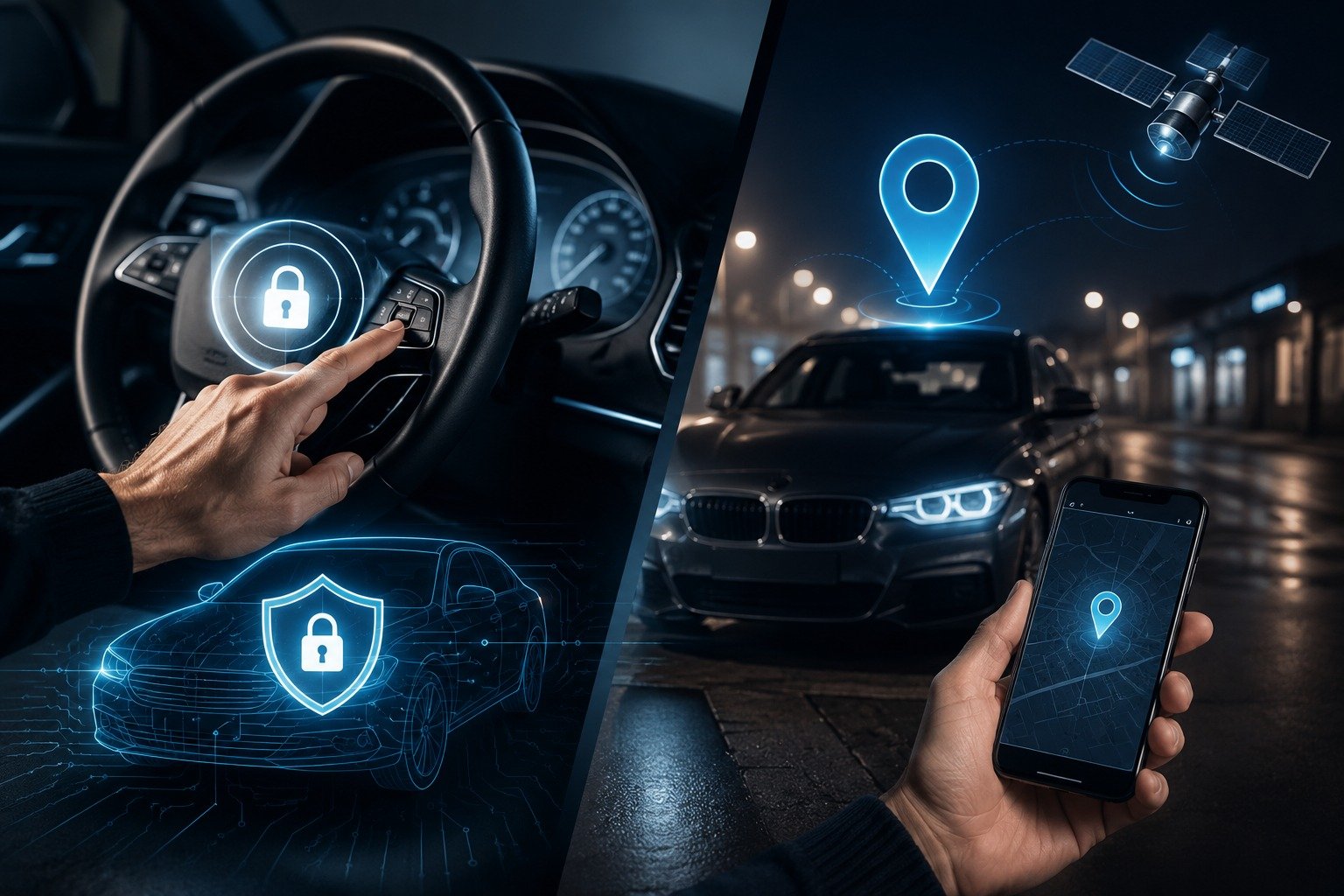
If you've started looking into protecting your car from theft, you've probably come across two names again and again: the Ghost immobiliser and the vehicle tracker. Both get talked about as "the answer" to modern car theft, and both get fitted by security installers like OJB Autocare on a daily basis. But they're not the same thing, they don't do the same job, and picking the wrong one for your situation can leave a gap in your protection that you didn't know was there.
This guide breaks down exactly what each system does, how they differ at a technical level, and which one actually suits your car, your driving habits, and your budget.
What Is a Ghost
Immobiliser?
A Ghost immobiliser, most commonly the Autowatch Ghost 2, is a CAN bus-based immobiliser that sits invisibly inside your vehicle's wiring. It has no fob, no LED, no siren, and no visible trace of being fitted. There's nothing for a thief to find, jam, or scan for.
To start the car, the driver enters a unique PIN sequence using the existing buttons already in the vehicle — things like the indicator stalk, the window switches, or the steering wheel controls. Get the sequence wrong, and the car will start but won't move properly, or won't start at all, depending on how it's configured. No PIN, no journey. It's that simple.
Because it works through the CAN bus rather than cutting a physical wire, a Ghost immobiliser is built specifically to defeat the theft methods that modern thieves actually use:
Relay attacks — where thieves amplify your key's signal from inside your house to unlock and start a keyless car parked outside.
Key cloning and signal jamming — where thieves intercept or duplicate your key fob's signal.
OBD port hacking — where thieves plug a device into the OBD port to programme a blank key or reset the vehicle's security system.
Since the Ghost has no signal to intercept and no fob to clone, these attack methods simply don't work against it.
What Is a
Vehicle
Tracker?
A vehicle tracker, by contrast, doesn't stop a car being stolen — it tells you and the recovery team where the car is after it's gone. Trackers typically use a combination of GPS (for location) and GSM (for communication with a monitoring centre), with newer systems also using GPS, GLONASS, and even driver-recognition technology to flag unusual movement patterns.
Most trackers fall into a few categories:
S5 trackers — vehicle tracking with automatic driver recognition, using a driver tag to help identify unauthorised use.
S7 trackers — asset location and recovery support; automatic driver recognition is not a required S7 feature.
Insurance-approved trackers — categorised by Thatcham Research (Category S5, S7) and often required by insurers for high-value or high-risk vehicles.
If the car is stolen, the tracker's monitoring centre is alerted, location data is passed to the police, and — in many cases — the vehicle is recovered within hours, sometimes before the thief has even left the area.
The Core
Difference:
Prevention vs
Recovery
This is the part that gets lost in most comparisons, and it's the single most important thing to understand:
A Ghost immobiliser is designed to stop the theft from happening in the first place. A vehicle tracker is designed to help recover the car once it's already gone.
They're not competing products solving the same problem — they're solving two different problems that happen at two different points in time. One acts before the theft. The other acts after it.
This is exactly why so many of the cars that disappear from driveways every week in the UK already had a tracker fitted but no immobiliser, or vice versa. A tracker won't stop a thief getting in and driving off. An immobiliser won't tell you where your car is if a thief somehow does manage to get past it.
Comparing
Them Side by
Side
Although both a Ghost Immobiliser and a vehicle tracker are designed to improve vehicle security, they work in very different ways.
A Ghost Immobiliser is focused on theft prevention. It stops unauthorised users from starting or driving the vehicle by requiring a unique PIN sequence before the engine can be activated. Because the system is completely hidden within the vehicle's electronics and has no visible LED lights, key fobs, or external indicators, it is virtually impossible for thieves to detect. It is also highly effective against modern theft methods such as relay attacks and key cloning.
A vehicle tracker, by contrast, is designed for theft recovery rather than theft prevention. If a vehicle is stolen, the tracker uses GPS and mobile network technology to provide real-time location data, helping owners, monitoring centres, and law enforcement agencies locate and recover the vehicle. Depending on the installation, some trackers may be discovered by experienced thieves.
When it comes to subscriptions, Ghost Immobilisers typically do not require ongoing fees after installation. Vehicle trackers, however, often require a monthly or annual subscription to cover GPS tracking, data transmission, and monitoring services.
Both systems can offer insurance benefits. Many insurers recognise the added security provided by a Ghost Immobiliser, while Thatcham-approved S5 and S7 trackers are particularly valued by insurance companies and may help reduce premiums.
A Ghost Immobiliser is often the preferred choice for keyless-entry vehicles and models frequently targeted by thieves. Vehicle trackers are particularly well suited to high-value cars, commercial fleets, motorhomes, and owners who want the reassurance of knowing their vehicle can be located if stolen.
For the highest level of protection, many vehicle owners choose to install both systems. The immobiliser helps prevent the theft from happening in the first place, while the tracker provides an additional layer of security should a theft occur.
Learn More: What to Do If Your Car Gets Stolen in the UK
Which One
Actually Stops
Your Car Being
Stolen?
If your priority is preventing theft outright — particularly relay attacks and OBD-port theft, which account for the vast majority of keyless vehicle thefts in the UK right now — a Ghost immobiliser is the more direct answer. It removes the vulnerability that thieves are actually exploiting.
A tracker doesn't address that vulnerability at all. It assumes the theft has already happened and focuses on what comes next.
Which One
Gives
You the Best
Chance of
Getting Your
Car Back?
If your car is taken despite every precaution, a tracker is what gives the recovery team a fighting chance. Without one, a stolen car becomes very hard to trace once it's moved a few streets, especially if it's heading straight to a shipping container or a chop shop, which is the reality for a large number of high-value stolen vehicles.
A Ghost immobiliser, on its own, offers no help here. If a determined thief somehow gets the car moving — through coercion, for example, or simply because the immobiliser wasn't engaged at the time — there's no fallback for locating it.
So Which Is
Better —
Realistically?
Asked as a straight either-or, the honest answer is that a Ghost immobiliser gives most drivers more practical protection for less ongoing cost, because it directly blocks the method thieves are currently using most. For the average keyless car owner parked on a driveway or street, prevention is the more pressing problem to solve.
But "better" depends heavily on your vehicle and your risk profile:
High-value, high-theft-risk vehicles (performance cars, certain SUVs, anything frequently targeted) often need both — a tracker for insurer compliance and recovery, and a Ghost for prevention.
Fleet vehicles and company cars benefit hugely from trackers for driver accountability and asset management, alongside a Ghost for theft prevention.
Standard keyless vehicles parked at home are usually well served by a Ghost immobiliser alone, particularly if relay attack is the main concern.
Insurance requirements sometimes dictate the choice for you — some insurers on certain vehicles will only offer cover, or a meaningful discount, if a Thatcham-approved tracker is fitted.
Can You Fit
Both?
Yes, and for many vehicle owners, this is actually the smartest option rather than an overcautious one. A Ghost immobiliser and a tracker solve different problems, so fitting both means you're covered at the point of attempted theft and, separately, in the rare event a vehicle is taken anyway. The two systems don't interfere with each other and are commonly fitted together on higher-value vehicles.
Learn More: How Thatcham Ratings Work: S1, S2, S5 and S7 Explained
Getting the
Right Setup
for Your
Vehicle
There's no single answer that applies to every car and every driver. The right choice depends on your vehicle's theft risk, whether it has keyless entry, what your insurer expects, and how much ongoing cost you're comfortable with.
At OJB Autocare, we fit Ghost immobilisers and Scorpion vehicle trackers across Yorkshire. Compare Scorpion S5-VTS, S7-ALS and Ghost tracker packages for device options, monitoring subscriptions and a combined quote. Send your vehicle details and any insurer requirements so we can check the right setup before booking.
Frequently Asked
Questions
1. How does a Ghost immobiliser
actually stop keyless car theft?
A Ghost immobiliser connects to the vehicle's CAN bus network and disables the ignition system until a unique PIN sequence is entered using the car's existing buttons. Since keyless theft relies on intercepting or relaying a key fob signal, and the Ghost doesn't use a fob at all, there's no signal for a thief to capture or amplify.
2. What's the difference between a
Thatcham Category S5 and S7
tracker?
S5 vehicle tracking includes automatic driver recognition, while S7 asset location systems do not require that feature. Scorpion S5-VTS uses driver tags; Scorpion S7-ALS provides tracking and recovery support without driver tags. Both Scorpion models require an active monitoring subscription. Check which category and exact model your insurer accepts.
3. Can thieves bypass a vehicle
tracker the way they bypass an
alarm?
Trackers are generally harder to bypass than visible alarms because they're hidden within the vehicle and don't rely on external sensors a thief can disable. However, a tracker doesn't stop the car being driven in the first place, so a thief who knows the vehicle is unprotected at the immobiliser level can still take it before any tracking alert triggers.
4. Does a Ghost immobiliser work on
hybrid and electric vehicles?
Yes. Ghost immobilisers are designed to integrate with a vehicle's CAN bus network, which exists across petrol, diesel, hybrid, and electric platforms. Installation specifics vary by make and model, since EV architectures route data differently, which is why professional fitting matched to the exact vehicle is essential.
5. Why are OBD port theft and key
cloning grouped together as a
security risk?
Both methods target the same weak point: a vehicle's ability to accept a new authorised key. OBD port theft involves plugging a device into the diagnostic port to programme a blank key, while key cloning duplicates an existing fob's signal. A CAN bus immobiliser like the Ghost blocks both, since neither method can complete the PIN sequence needed to drive.
6. Is a vehicle tracker worth fitting
on an older, non-keyless car?
It can be, particularly if the vehicle is high-value, frequently targeted for parts, or used commercially. Older non-keyless cars are less vulnerable to relay attacks, but they're not immune to theft through other means, and a tracker still provides recovery support and potential insurance benefits regardless of entry type.
7. Will my insurer require proof of
installation for a Ghost
immobiliser or tracker?
Many insurers do ask for an installation certificate, particularly for Thatcham-approved trackers used to qualify for cover or a premium discount. Reputable installers, including OJB Autocare, provide documentation confirming the device, fitting date, and approval category so it can be submitted directly to the insurance provider.
8. How does driver recognition
technology in an S5 tracker
actually work?
Scorpion S5-VTS uses a driver tag carried by an authorised driver. If the vehicle moves without a recognised tag, the system alerts the monitoring team. Automatic driver recognition is an S5 feature; it is not a standard S7 requirement.
9. Are Ghost immobilisers and
trackers legal to fit on any UK
vehicle?
Yes, both systems are legal aftermarket security devices and don't affect a vehicle's roadworthiness or warranty when fitted correctly by a qualified installer. Some manufacturer warranties specify approved fitting standards, so it's worth confirming installation method with the fitter to avoid any warranty complications.
10. Why do fleet operators often
choose trackers over
immobilisers as a priority?
Fleet operators are typically more concerned with vehicle location, route compliance, and driver accountability across multiple vehicles than with a single theft-prevention method. Trackers provide ongoing operational data beyond theft response, such as usage patterns and unauthorised movement, which is valuable for managing a fleet day to day, even though many fleets fit both systems together.